Prosecco is one of the most recognizable expressions of Italian wine on international markets. But behind this success lie profoundly diverse entrepreneurial entities: farms with estate-owned vineyards, wineries, sparkling wine production facilities, bottlers, commercial brands, and integrated groups.
For an industrial investor, a fund, or a family office, the initial question shouldn't be just how much it costs to purchase a winery, but above all what position that company occupies in the Prosecco supply chain and what concrete opportunities it offers for development and profitability.
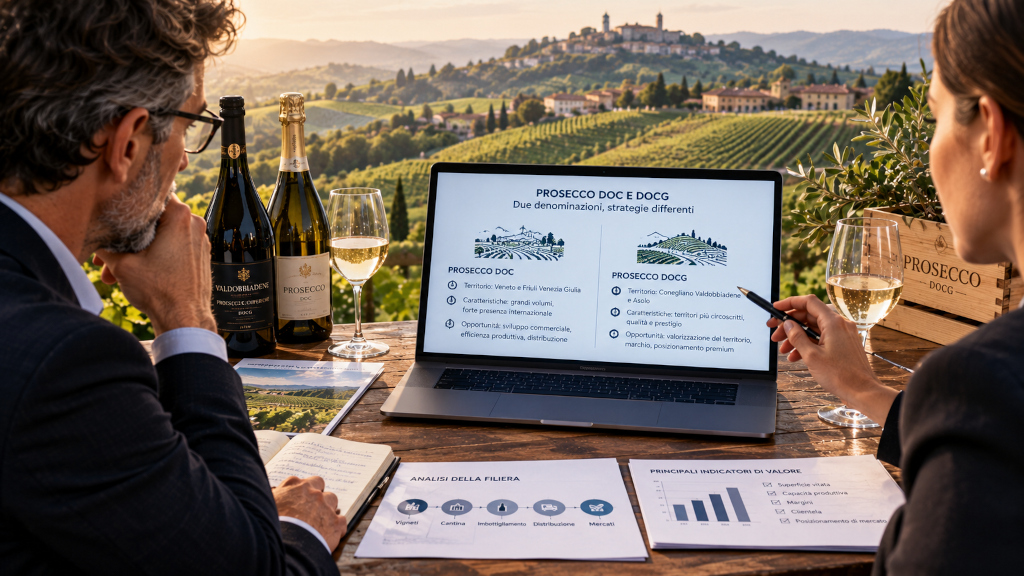
1. Prosecco DOC and DOCG: two denominations, different strategies
Prosecco DOC
A denomination extending across the Veneto and Friuli Venezia Giulia regions, it is characterized by a complex production system, with significant volumes and a strong presence on international markets.
Prosecco DOCG
It includes Conegliano Valdobbiadene Prosecco Superiore DOCG and Asolo Prosecco DOCG, more limited territories, with different production characteristics and positioning opportunities.
The distinction is fundamental to understanding the type of investment.
A company primarily focused on Prosecco DOC could be of interest to an industrial group looking to increase volumes, production efficiency, distribution, and an international presence.
A company rooted in the DOCG areas can instead offer opportunities linked to the availability of vineyards, territorial identity, branding, and positioning in higher price ranges.
Of course, no name is automatically more profitable than another. Profitability depends on the business model, costs, and the ability to transform the name's value into effective margins.
2. Owned vineyards and supplies: how independent is the winery?
One of the first checks concerns the origin of the grapes and base wines.
A company can process mainly its own grapes, purchase grapes from suppliers, use purchased base wine, or combine these methods.
Each model has advantages and risks.
Owning vineyards can ensure greater agricultural control and production continuity, but it requires significant capital and entails management costs.
The supplier system can allow for greater flexibility, but must be evaluated by considering the stability of relationships, contractual conditions and price trends.
It is therefore important for an investor to know:
It is also necessary to verify the specifications, the registered areas, and any measures applicable to production potential.
3. Production capacity: can the plants sustain growth?
A winery may have modern facilities, but only use a portion of its production capacity.
This element could represent an industrial opportunity, provided that there is a commercial prospect capable of absorbing the increase in production.
Before acquiring a company, it is necessary to verify its actual capacity for winemaking, storage, sparkling wine production, bottling, and packaging.
The condition of the systems, maintenance investments and any production bottlenecks must also be analysed.
Unused capacity doesn't automatically add value. It becomes attractive when it can be used to increase volumes and margins without requiring disproportionate investment.
4. Commercial distribution: where is Prosecco sold?
Two wineries with similar turnovers can have very different industrial values.
The first could sell mainly bulk product or operate with low margins for large customers.
The second could have recognized brands, established distributors, international contracts and a diversified customer portfolio.
The investor should examine the distribution of revenue between Italy and abroad, the markets served, the main customers, commercial concentration, and profitability by channel.
Particular attention deserves the distinction between own-brand sales, private labels, and products intended for other bottlers.
A high turnover does not necessarily guarantee a strong commercial position.
The value of a winery also depends on its ability to retain customers and defend prices over time.
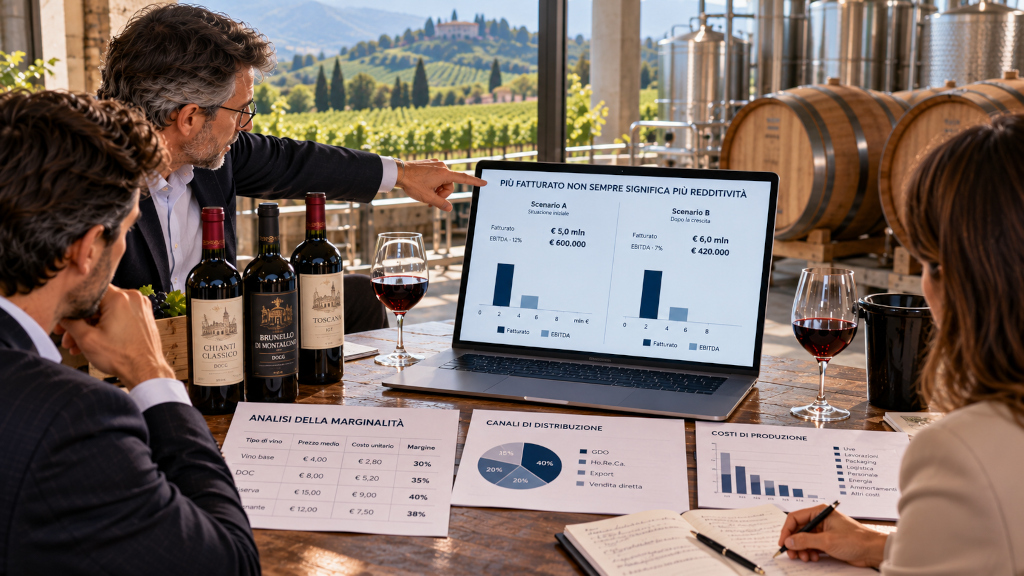
5. Profitability: Turnover doesn't tell the whole story of a company.
An industrial acquisition must start with an in-depth economic and financial analysis.
In addition to revenue and normalized EBITDA, you should also consider the product-specific industrial margin, raw material costs, sales expenses, working capital, debt, and required investments.
A particularly delicate aspect concerns the warehouse.
Wine inventories, finished bottles and packaging materials represent business assets, but they can also tie up significant financial resources.
For this reason, it is important to distinguish between the book value of inventories, their actual marketability, and the expected time frame for their realization.
An illustrative economic example
Let's consider two companies with the same annual turnover of 10 million euros, but different levels of profit margins.
|
Indicator |
Cellar A |
Cellar B |
|
Sales |
€10 million |
€10 million |
|
EBITDA |
€500,000 |
€1.5 million |
|
EBITDA Margin |
5% |
15% |
|
Production capacity used |
90% |
65% |
|
Positioning |
Volumes |
Brand and margins |
Comparison of operating margins
This example is purely illustrative and does not refer to real companies.
Cellar ACantina B
The second company generates a higher operating margin and has potentially exploitable residual production capacity.
This does not necessarily mean that it is the best investment: you also need to consider the asking price, the quality of the earnings, the debt, the financing needs and the operating risks.
6. Buying a winery or an industrial platform?
For some groups, the primary interest may be the territory, for others, production capacity, and for still others, access to customers and markets.
The main acquisition strategies can be traced back to three models.
Territorial acquisition
Investing in vineyards, real estate, the winery, and the denomination's identity, with a view to capital and production enhancement.
Industrial acquisition
Integrate production capacity, facilities, personnel and supplies within a group already present in the sector.
Commercial acquisition
Gain ownership of brands, customer portfolios, distribution relationships, and international positioning.
In some cases, the most interesting opportunities can arise from the integration of two or more complementary companies: one with strong product availability, another with industrial capacity, and a third with consolidated commercial distribution.
7. Essential checks before making an offer
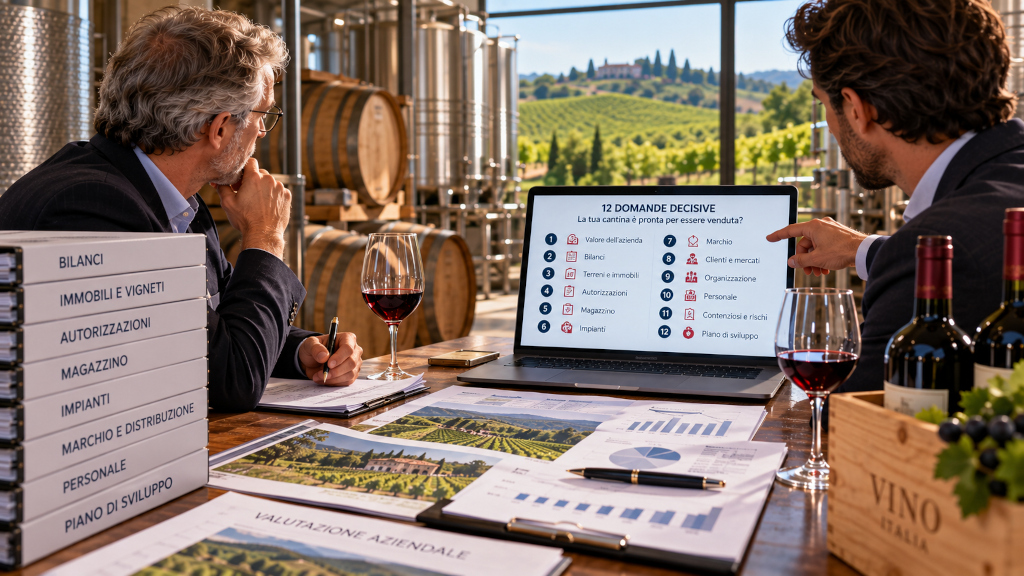
Before submitting a letter of intent, an investor should have sufficient information to evaluate at least seven elements: financial and asset situation, ownership of assets, plant compliance, authorization status, production availability, commercial relationships, and investment needs.
Particular attention must be paid to the continuity of relationships with suppliers, product certification, brand ownership, and any restrictions on land and buildings.
The preliminary check does not replace due diligence, but it allows you to establish a negotiation on a more solid foundation and identify critical issues promptly.
8. FORBUS's role in the Prosecco sector acquisitions
Acquiring a winery requires skills that go beyond real estate appraisal or financial statement analysis.
It is necessary to understand how the supply chain works, price dynamics, the relationships between producers and suppliers, commercial positioning, and the possibilities for industrial integration.
Through its network and multidisciplinary team, FORBUS supports industrial groups, private investors, and family offices in the research, evaluation, negotiation, and acquisition of wineries.
The activity includes identifying opportunities consistent with the buyer's profile, preliminary analysis of industrial and commercial potential, coordination of the professionals involved, and support until the transaction is concluded.
The goal is not simply to identify a winery available for sale, but to identify a company capable of generating value for the investor.
Conclusion: the value of Prosecco is in the enterprise, not just in the denomination
Prosecco DOC and DOCG offer various investment opportunities, but each acquisition must be evaluated based on the specific characteristics of the company.
The land, vineyards, facilities, procurement, brands, and distribution are all important factors. However, what determines the sustainability of the operation is their ability to generate economic and financial results over time.
A good acquisition is not necessarily the one with the lowest price, but one whose industrial, commercial, and capital value is consistent with the invested capital and the buyer's objectives.
Investing in Prosecco DOC and DOCG: Let's talk about it
FORBUS selects and analyzes acquisition opportunities in the Italian wine sector, including through confidential transactions.
If you represent a winery group, an industrial company, a family office, or an investor interested in the Prosecco sector, we can discuss the characteristics of the investment you're seeking.
Request opportunities that match your profile
FORBUS – Strategic Business Advisory
Transactions, not announcements. Where negotiations begin.
05/11/2026
04/11/2026
03/11/2026
31/10/2026