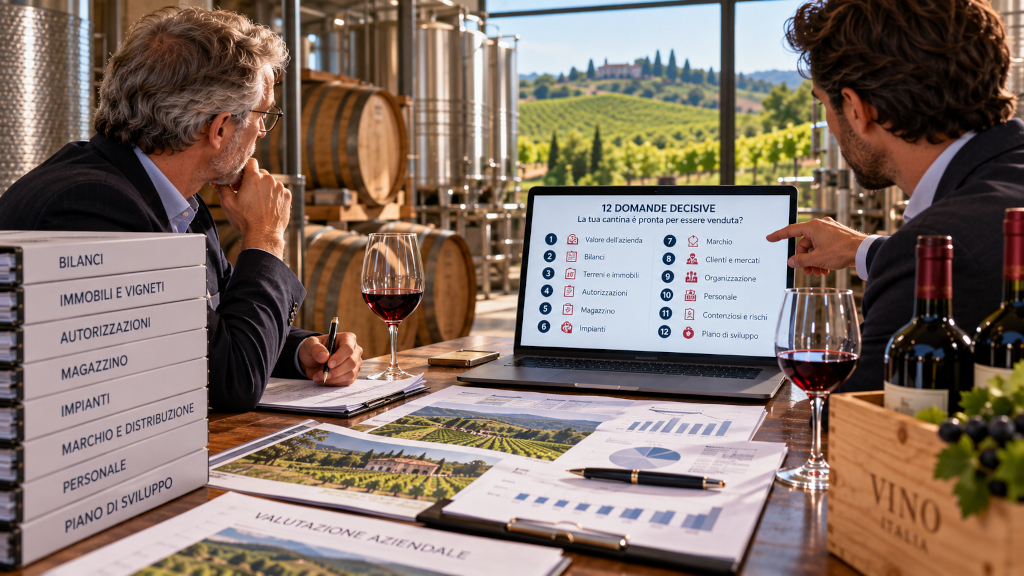
Sell a winery, prepare the sale of a winery, and enhance your assets before an investor arrives.
Many winery owners begin to consider selling when faced with a challenge: a lack of generational change, business difficulties, the need for new investments, rising costs, or simply the desire to conclude a long entrepreneurial journey.
But there is a fundamental difference between wanting to sell a cellar and actually being ready to sell it .
A qualified investor doesn't just buy vineyards, real estate, equipment, and bottles. He or she evaluates the company's income-generating capacity, its structural strength, its market positioning, its risks, and its development potential.
For this reason, FORBUS offers owners an initial practical exercise: answering 12 questions that allow them to understand how prepared the company is to face a possible sale.
1. Do you know the real value of your cellar?
The sentimental value of a company built over decades of work does not necessarily coincide with that recognized by the market.
An appraisal must consider land, vineyards, buildings, equipment, brands, inventory, debt, earnings capacity, and business prospects.
Crucial question: is the price you'd like to achieve supported by a documented economic, asset, and industrial valuation?
2. Do the financial statements for the last three financial years clearly represent the company's situation?
Buyers want to understand turnover, profitability, costs, debt and cash flows.
It's not enough to demonstrate that the company produces good wine: it's necessary to demonstrate that the business can sustain itself financially.
Crucial question: Can you explain the performance of the last three financial years and any differences between accounting results and actual management?
3. Are land, vineyards and buildings properly documented?
Surface areas, properties, rental agreements, land registry data, urban planning uses, buildings, and compliance must be verifiable.
Any discrepancies, constraints, or unclear situations can slow down the negotiation and affect the price.
Crucial question: are all the property, urban planning, and land registry documents available, up-to-date, and consistent?
4. Are the wine-growing permits and rights in order?
An operational winery must be able to demonstrate the regularity of the activities carried out.
The applicable production and environmental permits, the viticultural register, the registers, the sectoral requirements and the documentation relating to the denominations are important.
Crucial question: could a buyer quickly verify the company's administrative and production compliance?
5. Do you know the actual value of the inventory?
Bulk wine, bottles, products undergoing aging, materials, and inventories represent assets, but not all inventory necessarily has the same commercial value.
It is necessary to verify quantity, quality, vintages, costs, rotation, saleability and consistency with market prices.
Crucial question: Does the book value of the inventory correspond to an economically realizable value?
6. Are the systems efficient and suitable for future plans?
A winery may have significant facilities, but only use a portion of its production capacity.
For an investor, this can represent an opportunity or an additional cost, depending on the condition of the facilities and the commercial possibilities.
Crucial question: Do you know your actual production capacity, utilization rate, and the investments needed in the coming years?
7. Does the brand have a recognizable commercial value?
A historic brand does not automatically generate a higher sales price.
What counts is its ability to sustain sales, margins, distribution and recognition among customers.
Crucial question: is the trademark registered, properly titled, and supported by demonstrable commercial results?
8. How much does your turnover depend on just a few customers?
Concentrating sales on one or two major distributors, importers, or customers can pose a risk.
A buyer will analyze the continuity of business relationships, margins, contractual conditions, and market diversification.
Crucial question: if your main customer lost business tomorrow, what impact would it have on your business?
9. Can the organization function without an owner?
In many wineries, the owner personally oversees production, purchasing, sales, administration, and commercial relations.
This centrality can become a critical issue at the time of transfer.
Crucial question: are there personnel, skills, procedures, and responsibilities to ensure operational continuity after a change of ownership?
10. Have you identified debts, commitments and potential liabilities?
Financing, leasing, guarantees, litigation, contracts, and obligations to employees and suppliers can all impact the value of the transaction.
Upfront transparency reduces the risk of disputes during buyer verification.
Crucial question: are you aware of all the obligations that could affect the final price or terms of sale?
11. Do you know exactly what you want to sell?
Selling company shares, selling the operating company, or transferring individual properties and vineyards are different operations.
The entry of an industrial or financial partner can also represent an alternative to a total sale.
Each solution has economic, legal, and tax implications that should be evaluated with the relevant professionals.
Crucial question: do you want to exit the business entirely, keep a stake, or keep part of the real estate assets?
12. Have you defined your objectives, timing and conditions of the sale?
A negotiation can take months and, in more complex transactions, even longer.
It is necessary to establish financial expectations, mandatory conditions, payment methods, availability for a period of support, and a level of confidentiality.
Crucial question: are you really willing to sell under the conditions that the market would recognize?
The FORBUS test: how ready is your cellar?
The 12 questions constitute an initial indicative check, not an appraisal or a price evaluation.
For each question assign:
Indicative result:
Caution: A high score does not guarantee saleability. Even a single significant issue, such as regarding property ownership, permits, or debt, can prevent or affect a transaction.
Sell now or capitalize first?
This is often the most important decision.
A winery may have significant assets but modest financial results, unused production capacity, underdeveloped foreign markets, or a brand that hasn't yet fulfilled its potential.
In these situations , immediately putting the company on the market is not always the best choice .
An enhancement program can intervene on:
The goal is not to artificially increase the asking price, but to create the conditions for the company to express a greater and more credible value.
How FORBUS intervenes
FORBUS supports winery owners, wineries, and industry groups at key moments in their business life: development, valorization, investor participation, and divestment.
Our approach starts with an analysis of the real situation and continues with the definition of the most suitable path for the property.
Work may include:
Not all wineries need to be sold. Some can be developed, others reorganized, and still others may find greater value through industrial partnerships or the entry of new shareholders.
The starting point is to understand which choice can best protect the property's assets and objectives.
Request a marketability check for your cellar
Are you thinking of selling your winery in the coming months or years? Or do you simply want to understand its true potential before making a decision?
FORBUS offers an initial, confidential meeting to determine the company's current level of preparedness, key critical issues, and potential enhancement or divestment strategies.
Request a marketability check.
Visit www.forbus.it and present your company confidentially.
FORBUS – Transactions, not announcements. Where negotiations begin.

03/11/2026
31/10/2026

29/10/2026

28/10/2026