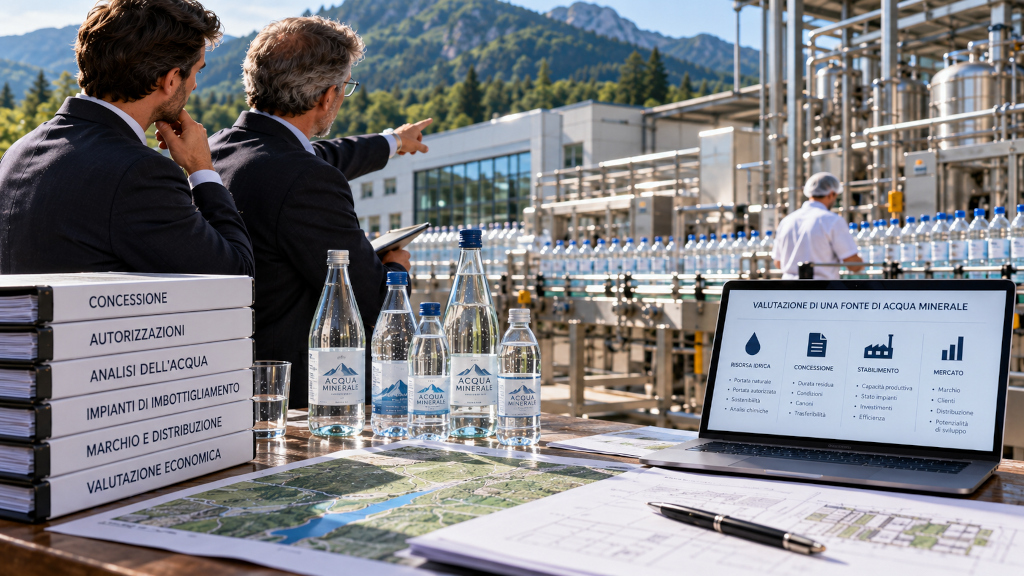
Value depends not only on land, buildings, and machinery, but on a combination of elements that can make the business particularly attractive to an industrial group, a beverage producer, or an investor.
The availability of water resources, the solidity of the concession, authorizations, production capacity, and commercial development opportunities are often the elements that determine the buyer's real interest.
For this reason, before offering a property on the market, it is essential to prepare the transaction from a technical, industrial, economic, and documentary perspective.
1. The mining concession: the first element to verify
A mineral water source cannot be evaluated as a simple land with a spring.
In Italy, the exploitation of natural mineral waters is subject to specific regulations, involving the Regions and the competent authorities.
Before starting a sale you need to check:
A key aspect is that the sale of the company or properties does not necessarily automatically transfer the right to exploit the source. Regional regulations, the concession, and the required authorizations must be verified.
A well-documented concession, with an adequate duration and clear conditions, can significantly contribute to the attractiveness of the investment.
2. Water availability and water characteristics
The buyer must understand not only how much water is available, but also how sustainable its use is over time.
Documentation should include hydrogeological studies, chemical and microbiological analyses, historical flow data, source monitoring, and information on protected areas.
It is important to distinguish between three values:
These values do not necessarily coincide.
A source with water availability greater than the current bottling capacity may offer opportunities for expansion, provided they are technically feasible and permissible.
3. Factory and facilities: how much is the production structure worth?
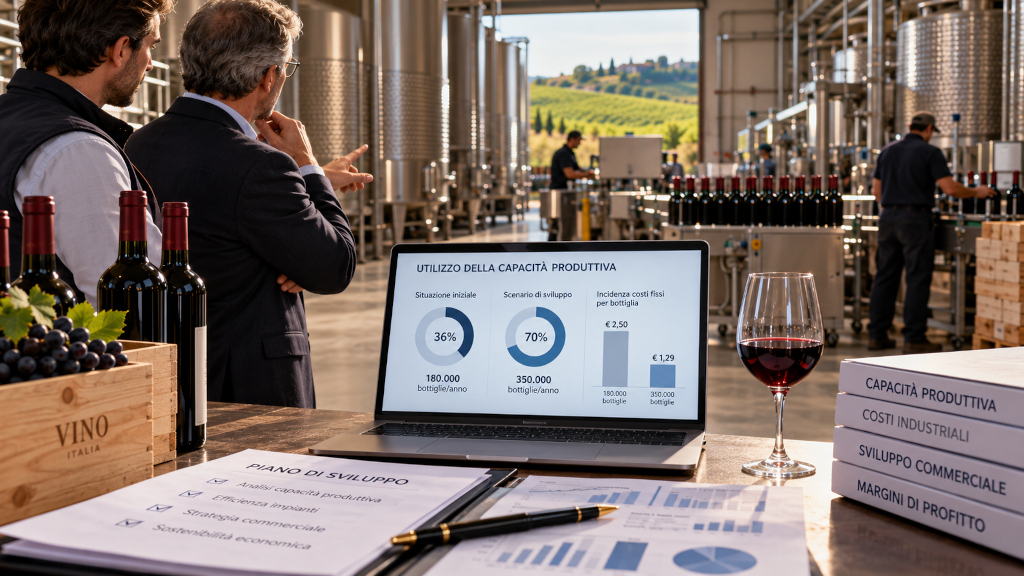
When the sale includes a bottling plant, the valuation must take into account the actual condition of the facilities and their competitiveness.
It is necessary to analyze the bottling lines, the formats that can be processed, the hourly capacity, the age of the machinery, maintenance interventions, energy consumption, packaging systems and expansion possibilities.
A modern, functioning line can be an advantage for an industrial buyer. Conversely, obsolete or underutilized equipment requires an evaluation of upgrade costs.
Industrial value doesn't necessarily coincide with the historical cost of the plants or their book value. It also depends on productivity, operating conditions, and the ability to generate economic results.
4. Authorizations and compliance: avoiding surprises during the negotiation
One of the most common reasons for slowdowns in industrial operations is the presence of incomplete documentation or authorization situations that need to be clarified.
Before contacting investors, it is advisable to check the documentation relating to:
The presence of critical issues does not necessarily make the sale impossible, but they must be recognized and managed before they become an obstacle to closing the transaction.
5. Commercial value: brand, customers and distribution
A source can be interesting even in the absence of a particularly well-known brand, especially when it has favorable water, logistical, or industrial characteristics.
However, when there is a consolidated commercial activity, it is necessary to consider the value of the brand, the positioning of the products, the contracts with distributors and customers, the presence in large-scale distribution and the margins per channel.
Contract manufacturing and private label opportunities can also play a significant role.
For a beverage group, acquiring an already operating plant can mean rapidly increasing production capacity or entering a new territory without building a plant from scratch.
6. What documents should I prepare before selling?
Preliminary documentation for the confidential dossier
Preliminary verification of available documentation
0/9
Concession title and related conditions
Hydrogeological studies and resource analysis
Health, environmental and industrial authorizations
Floor plans, cadastral data and real estate assets
List of plants and production capacities
Balance sheets and economic data for the last three financial years
Production, sales, customers and main contracts
Trademarks, patents and other available rights
Necessary investments and expansion possibilities
Copy the checklist
Complete documentation will normally only be shared with qualified counterparties and after appropriate confidentiality agreements have been signed.
7. How to find the right buyer
Not all investors are looking for the same type of asset.
A mineral water producer may be interested in increasing its production capacity. A beverage group may be seeking an industrial platform to diversify its production. A financial investor may be evaluating the potential for economic and commercial revival.
For this reason it is necessary to distinguish between:
Sources to be developed: opportunities based on water resources and the implementation of an industrial project.
Operational facilities: already authorized and equipped facilities, with the possibility of production continuity.
Complete beverage companies: businesses with brands, revenue, sales organization, and customers.
Businesses to be relaunched: companies requiring investment, reorganization, or new markets.
The search for a buyer must start from the real characteristics of the transaction, not from simply publishing an advertisement.
8. How to prepare an effective confidential dossier
The first document presented to the market should be an anonymous teaser, detailed enough to allow for an initial evaluation, but without revealing any identifying information about the property.
It should contain a summary of the opportunity, the geographic area, the characteristics of the water resource, the production capacity, the size of the assets and the development possibilities.
Subsequently, a more detailed dossier can be shared with the selected investors, the documentation verified, and the acquisition terms defined.
9. Sell the company, business or individual assets?
Another fundamental choice concerns the structure of the operation.
The transfer of company shares, the sale of the company or a branch of the company, and the sale of individual properties and plants produce different effects.
The most suitable solution depends on the company's financial and asset situation, ownership structure, existing contracts, and the transferability of administrative titles.
It is therefore necessary to involve legal, tax, and technical professionals to identify a sustainable structure that complies with applicable regulations.
10. The role of FORBUS: from evaluation to completion of the transaction
FORBUS supports owners of mineral water springs, bottling plants, and beverage companies in their valorization and sale operations.
Our work unfolds through a concrete process: preliminary property analysis, identification of valuable assets, preparation of confidential documentation, search for qualified counterparties, negotiation management, and coordination of the professionals involved until the transaction is concluded.
The goal is not simply to find an interested party, but to create the conditions so that a property can be properly presented, evaluated, and negotiated with truly qualified interlocutors.
Knowledge of the sector and its industrial specifics is crucial to distinguishing a real opportunity from a difficult-to-achieve investment.
Conclusion: preparing the sale well means protecting the value
A mineral water spring or a bottling plant can represent a significant industrial asset, even when the business has not yet reached its full potential.
Selling at the best conditions requires preparation, confidentiality, realistic valuations, and the ability to communicate with investors who understand the sector.
Before putting a source or plant on the market, the question to ask is not just how much it is worth today, but what value it could represent for the right buyer.
Do you have a mineral water source or a factory to sell?
FORBUS can help you evaluate the property, prepare a confidential dossier, and identify potential Italian and foreign industrial and financial buyers.
Talk to FORBUS about your property. An initial, confidential meeting can help you understand the real possibilities for enhancing its value and selling it.
FORBUS | Analysis · Enhancement · Acquisitions · Industrial Divestments

28/10/2026
27/10/2026

26/10/2026

25/10/2026