The hidden value in Italian cellars
In Italy, there are numerous wineries with modern cellars, winemaking facilities, bottling lines, tanks, and production facilities that are only partially utilized.
These are investments made over the years, often with significant financial resources, which today are not realizing their full potential.
A winery designed to produce 500,000 bottles per year, but only sells 180,000, may have significant spare production capacity.
This doesn't automatically mean it can produce another 320,000 bottles without new investments. It does, however, mean that there is an industrial heritage to be analyzed and, when conditions allow, valorized.
The real question is not how much a winery can produce, but how much it can produce and sell with adequate margins, without compromising the company's financial stability.
1. Unused production capacity represents a cost, but also an opportunity
A production structure generates costs even when it works below its capacity.
Depreciation, maintenance, insurance, personnel, energy, and property management all impact the balance sheet regardless of actual sales volumes.
When production is insufficient, these costs are distributed over a limited number of bottles, increasing the unit industrial cost.
Higher capacity utilization can allow some fixed costs to be spread across higher volumes, improving overall efficiency.
However, increased production must be accompanied by an adequate trade margin and proper working capital management.
Producing more without selling better can simply turn unused capacity into unsold inventory.
2. How to measure the real production efficiency of a winery
Before developing any development project, it is necessary to understand the company's industrial situation.
The analysis must consider:
It is also important to distinguish between theoretical production capacity, actually available capacity and economically viable capacity.
A bottling line may operate at a high rate but become inefficient due to frequent format changeovers, small batch sizes, or lack of staff.
3. A concrete example: how much can the economics of a winery change?
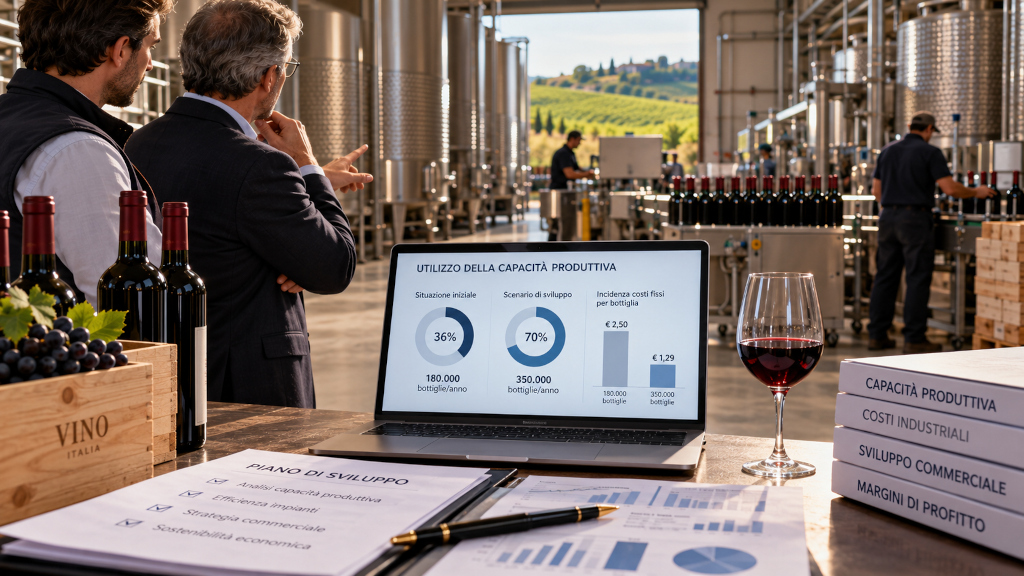
Let's consider a simplified simulation of a winery with a theoretical production capacity of 500,000 bottles per year.
Simulation of production capacity utilization
Initial situation
36%
180,000 bottles/year
Development scenario
70%
350,000 bottles/year
Current
36%
Objective
70%
Incidence of industrial fixed costs per bottle
|
Estimated annual fixed costs |
€450,000 |
|
With 180,000 bottles |
€2.50/bottle |
|
With 350,000 bottles |
€1.29/bottle |
This simulation is purely illustrative. Fixed costs and available capacity are assumed unchanged. Variable costs, any additional investments, financial charges, and commercial costs are excluded.
The example shows how increased plant utilization can reduce the incidence of unit fixed costs.
The actual economic benefit will, however, depend on the selling price, additional costs, collection conditions and the ability to permanently place the increased production.
4. Five opportunities to enhance existing facilities
Contract manufacturing. A winery can make its facilities available to vinify, process, bottle, or package other companies' products. This is an attractive option when the appropriate technical capabilities and authorizations are available.
Industrial agreements between wineries. Companies with complementary needs can share certain processes, reducing duplication of investment and improving facility utilization.
Brand and private label development. Available capacity can be used to produce for distributors, importers, or specific commercial projects, provided that sustainable volumes, financial terms, and payments are guaranteed.
Expanding commercial markets. A winery with competitive products but a limited distribution network can develop new channels in Italy and abroad, linking sales growth with production planning.
Entry of industrial partners or investors. When unused capacity is significant, it may be appropriate to consider collaborations, shareholdings, mergers, or acquisitions aimed at creating economies of scale.
There's no one-size-fits-all solution. The choice depends on the winery's location, its resources, the local area, and the owner's goals.
5. Caution: Increasing volumes can worsen your financial situation
One of the most common mistakes is to consider increasing production as an automatic solution to profitability problems.
To produce larger quantities of wine, raw materials, materials, energy, personnel and financial resources are needed.
Furthermore, several months may pass between the time of production and the time of collection.
An increase in volumes can therefore generate a greater need for liquidity.
Before starting the project, it is necessary to verify at least three fundamental conditions: the presence of positive industrial margins, the existence of reliable commercial outlets, and the availability of adequate financial resources.
The goal shouldn't be to fill the cellar, but to improve the company's financial results.
6. The FORBUS method: from unused capacity to industrial project
FORBUS supports winery owners, wineries, and industrial groups in analyzing and enhancing their production facilities.
The intervention does not limit itself to identifying underutilized facilities, but considers the entire company organization.
The process can be divided into four phases.
Industrial analysis
Verification of structures, systems, costs, human resources and actual production capacity.
Economic and financial evaluation
Identify incremental margins, required investments, and liquidity needs.
Developing opportunities
Search for manufacturing partners, commercial operators, investors, and potential industrial agreements.
Project implementation
Coordination of the technical, industrial, commercial, and financial skills required to implement the plan.
The goal is to transform a production potential into a concrete, sustainable and measurable project.
7. A new perspective for investors too
A winery with unused production capacity is not necessarily a company in difficulty.
In some cases it can represent an interesting industrial investment opportunity.
For a winery already present on the market, acquiring or using an existing production facility may be more cost-effective than building new facilities.
The value of the transaction, however, depends on the condition of the properties, the efficiency of the technologies, permits, compliance costs and commercial prospects.
Unused capacity, by itself, does not constitute a certain added value: it becomes an element of value when there is a credible plan to use it profitably.
Conclusion: before investing in new plants, let's enhance the existing ones
The Italian wine sector is facing a phase that requires greater attention to costs, liquidity, markets, and industrial efficiency.
In this context, leveraging what companies already possess can represent an important strategic choice.
Many wineries may have development opportunities that have not yet been fully explored: available winemaking capacity, underutilized bottling lines, production space, and professional expertise.
The starting point is an independent analysis, capable of distinguishing concrete opportunities from unsustainable expectations.
Before building a new winery, purchasing additional equipment, or seeking new financing, it's worth understanding how much value your existing facility can still generate.
FORBUS | Request an industrial analysis of your cellar
Does your winery have partially used facilities, tanks, or production lines?
FORBUS can assist you in evaluating production capacity, identifying development opportunities, and finding industrial and commercial partners.
We don't just suggest solutions: we work to transform them into concrete operations.
One team, one project, shared goals.

26/10/2026

25/10/2026

24/10/2026
23/10/2026