Selling a winery is one of the most important decisions in an entrepreneur's life. Yet, too often, the sale is approached without first assessing the company's true value through targeted interventions.
The result? The risk of selling a legacy built over decades of work at a price below its potential.
The question to ask is not just "How much is my cellar worth today?", but above all "How much could it be worth if it were managed and valued better?"
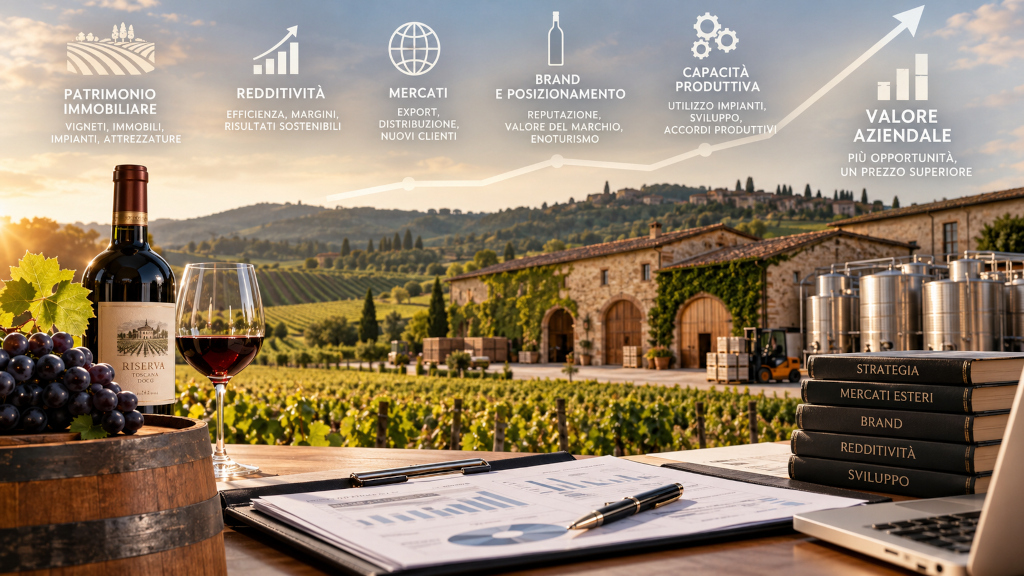
1. The value of a cellar does not coincide with its real estate assets
Land, vineyards, buildings, a cellar, machinery, and equipment represent a fundamental component of a company's value. But for an industrial investor, they're not enough.
Those who buy a winery also evaluate its ability to generate profits, generate cash, retain customers, and develop new markets.
A winery with 20 hectares of vineyards, modern facilities, and a well-known brand could have a significantly different value than another with similar financial characteristics but weaker commercial and operational results.
For this reason, it is important to distinguish between asset value, economic value, and strategic value.
The actual price achievable will also depend on the company's financial situation, market conditions, prospects, and the interest of potential buyers.
2. Unused production capacity: an often overlooked opportunity
Many wineries have facilities and systems designed for volumes greater than those actually produced or marketed.
This means that a portion of the investments made do not fully contribute to the company's profitability.
Before selling, it is useful to analyze:
A sustainable increase in capacity utilization can improve the absorption of fixed costs and make the company more attractive to a buyer.
Of course, producing more doesn't necessarily mean earning more: you need to ensure there's adequate demand, margins, and financial resources.
3. Profitability: Turnover alone does not determine value
A winery can have a turnover of several million euros and have limited profitability.
On the contrary, a smaller, but well-organized cellar with correctly positioned products can be particularly interesting.
Before initiating a sale, it is therefore essential to verify the profitability of individual product lines, the actual cost of each bottle, margins by customer and sales channel, inventory turnover, and the impact of overhead costs.
Particular attention must be paid to stocks: wine in storage has value only if it is commercially saleable under economically sustainable conditions.
Reducing inefficiencies, improving margins, and making financial results more predictable can positively impact a company's valuation.
4. Export and distribution: the value of a winery grows with its markets
A winery that is heavily dependent on a few customers or a single market presents commercial risks that a potential buyer cannot ignore.
Diversification of distribution can instead make the company more solid.
Before selling, it's important to evaluate your presence on foreign markets, the quality of your importers and distributors, the continuity of your orders, your export margins, and the potential for expanding your sales channels.
It's not always necessary to immediately enter new countries. Sometimes it's more useful to consolidate existing ones, review trade agreements, and improve product positioning.
For an industrial group interested in an acquisition, a reliable distribution network can represent a significant strategic advantage.
5. Brand and positioning: the value that doesn't appear in real estate
A winery's brand can represent a significant asset, especially when it is supported by a consolidated reputation, a recognizable history, and a loyal customer base.
But simply owning a historical label is not enough to automatically attribute a high value to it.
It is necessary to verify the brand's recognition, its legal protection, its price positioning, its commercial presence and its ability to generate sales and margins.
Wine tourism, tastings, direct sales, and hospitality can also contribute to the development of a business, when the territorial, organizational, and economic conditions exist to develop them.
A winery must be presented to the market not only for what it possesses, but also for what it is concretely capable of becoming.
6. How much can better management impact company value?
Let's consider a purely illustrative example, referring to a winery for which it is also appropriate to use a valuation method based on EBITDA, i.e., gross operating margin.
Example of economic valorization
Hypothetical values, not referring to a specific company
|
Annual turnover |
€3,000,000 |
|
Initial EBITDA |
€240,000 |
|
EBITDA after interventions |
€360,000 |
|
EBITDA increase |
50% |
€0€ 500,000€ 1M€ 1.5M€ 2MBeforeAfter
Hypothetical scenario with a constant multiple of 5x EBITDA; enterprise values before net financial position and other adjustments.
In this example, a stable increase in EBITDA of €120,000 could correspond to €600,000 of increased enterprise value, maintaining a purely hypothetical multiple of 5x.
This isn't a promise of appreciation. The actual multiple, business risk, required investments, and debt can significantly alter the result.
Furthermore, for many agricultural and winemaking businesses, the value of land and buildings requires an independent analysis, avoiding duplication in the overall assessment.
However, the example demonstrates an important principle: intervening on profitability before selling can substantially change the outcome of a negotiation.
7. Sell now or capitalize first?
Not all wineries need to be sold immediately. And not all need to undergo lengthy reorganization programs.
The choice depends on the business situation, the ownership objectives and the time available.
In some cases, it may be best to begin the sale process immediately. In others, a 12–24-month development process can allow you to present a company with stronger results, better organization, and more credible prospects.
There is also a third option: involving an industrial or financial partner to develop the business without necessarily immediately relinquishing control.
The decision must arise from a concrete analysis, not from the simple expectation of obtaining a higher price.
8. The FORBUS method: first understand the potential, then decide
FORBUS was created to support winery owners, wineries, and investors in decisions regarding the development, valorization, and sale of their businesses.
Our approach integrates economic, production, commercial and strategic skills.
The process develops through six steps:
Business Analysis — Understanding assets, financial results, organization, and critical issues.
Valuation — Determine current value and identify realistic potential.
Positioning — Define priority interventions and the most appropriate strategy.
Research — Identify qualified partners, investors, or potential buyers.
Negotiation — Build and coordinate a negotiation consistent with the ownership objectives.
Closing — Accompany the operation through to its conclusion, together with the professionals involved.
The goal is not simply to find someone willing to buy a winery, but to create the conditions for the owner to make an informed decision and achieve the best realistic outcome.
Conclusion: the best time to valorize a cellar is before putting it up for sale.
An entrepreneur who has dedicated decades to his company deserves to know the value of the assets he has built, but also the opportunities that have not yet been developed.
Unused production capacity, profitability that can be improved, markets to consolidate, brands to enhance, and new industrial projects can all represent important elements for a future operation.
The real difference lies in recognizing them early, assessing their sustainability, and transforming them, where possible, into measurable results.
Before selling a winery, you need to understand whether you're selling a business at its full potential or an opportunity that someone else can capitalize on.
Discover your company's potential
Are you considering selling your winery, bringing in a partner, or developing a new business?
FORBUS can assist you in analyzing current value, identifying improvement opportunities, and defining a valorization or divestment path.
Before you decide how much to charge for your business, find out what it might actually be worth.
FORBUS – Strategic Business Advisory | Development, Enhancement, and Extraordinary Transactions
Discover your company's potential : https://www.forbus.it/?utm_source=chatgpt.com

22/10/2026

22/10/2026

19/10/2026

19/10/2026