Buying a winery isn't simply about purchasing vineyards, buildings, equipment, and bottles of wine. It means entering a business with its own history, market, business relationships, obligations, permits, and economic prospects that must be understood before making any commitments.
A winery may own highly valuable vineyards and, at the same time, be experiencing financial difficulties. It may have a well-known brand but insufficient profitability. Or it may have modern production facilities, only partially utilized, and represent an interesting development opportunity.
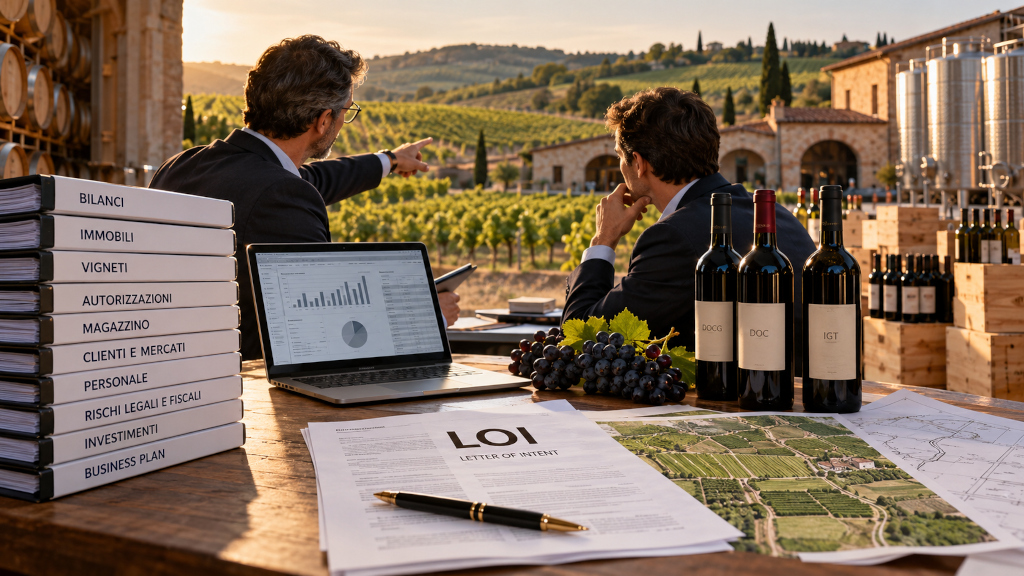
For this reason, before signing a LOI (Letter of Intent), it is advisable to carry out a preliminary verification of the investment.
The LOI does not replace full due diligence, which is typically conducted in later phases. Instead, it serves to define the terms of a potential acquisition, the process of review, and any commitments of the parties.
The 10 essential checks before buying a cellar
1. Balance sheets and real economic situation
Turnover alone does not determine the value of a winery.
It is necessary to examine at least the last three financial years, verifying revenues, operating margins, net income, debt, liquidity and cash generation capacity.
Particular attention must be paid to trade receivables, inventories, and any overdue debts.
Fundamental question: Is the company generating profits and cash flow, or does it need ongoing financing to sustain its operations?
2. Property ownership and financial situation
Land, vineyards, cellars, buildings, and systems must be identified and verified.
It is necessary to ascertain the ownership of the assets, the presence of mortgages, easements, liens, rental agreements and possible land registry or urban planning irregularities.
It must also be clarified whether the properties belong to the company being acquired or to partners or third parties.
Fundamental question: are all the assets presented in the negotiation actually included in the transaction and freely transferable?
3. Vineyards, areas and production potential
The declared hectares are not sufficient to value a wine-growing property.
It is necessary to know the actual areas under vine, the vines, the age of the plants, the agronomic state, historical yields, management costs and any replanting interventions.
It is also necessary to verify the vineyard register, the claimable areas, the authorizations and compliance with the DOC, DOCG and IGT designations.
Fundamental question: how much can those vineyards actually produce in the next ten years and at what cost?
4. Business authorizations and compliance
An operating winery must have the necessary qualifications and qualifications to carry out its activities.
Depending on the company's characteristics, building, environmental, health, safety, waste management, fire prevention, and winemaking compliance aspects must be verified.
It is also necessary to determine which authorizations are transferable and which require communications, updates, or new procedures.
Key question: Can business continue as normal after the acquisition without costly adjustments or disruptions?
5. Warehouse: quantity, quality and commercial value
The warehouse often represents one of the most important and sensitive assets.
Bulk wine, bottles, products undergoing aging, packaging materials, and stocks must be verified for quantity, quality, traceability, and actual realizable value.
A wine valued at a certain value may not necessarily be sold at that price.
Fundamental question: is the warehouse a commercial resource or a hard-to-recover fixed capital?
6. Customers, markets and distribution
A winery may declare a significant turnover, but depend on few customers or a single market.
It is advisable to analyze revenue concentration, main distributors, geographic distribution, commercial contracts, margins by channel and the stability of relationships.
Exports, in particular, must be evaluated based on results and not just the countries in which the company claims to be present.
Fundamental question: by purchasing the winery, do you also acquire a commercial structure capable of supporting sales?
7. Staff, skills and organization
The value of a winery also depends on the people who operate it.
Oenologists, production managers, agricultural, sales, and administrative staff represent skills that can be crucial to business continuity.
It's important to check staffing, labor costs, contracts, potential disputes, and dependencies on key figures, including the current owner.
Fundamental question: can the company continue to operate effectively even after the current ownership leaves?
8. Brands, reputation and commercial positioning
Branding can be a significant asset, but it must be supported by concrete results.
Registrations, ownership, markets of use, recognition, average prices, sales continuity and ability to differentiate from the competition must be analyzed.
Wine awards and recognitions can contribute to reputation, but they do not automatically demonstrate the profitability of the brand.
Fundamental question: does the market recognize added value in the company's wines or does the company compete primarily on price?
9. Investments required after the acquisition
The purchase price is only a part of the overall investment.
Vineyard interventions, plant modernizations, regulatory compliance, business development, working capital replenishment, or new management resources may be necessary.
For this reason, it is advisable to prepare an economic and financial plan that also considers post-closing investments.
Fundamental question: How much capital will it actually take to acquire, operate, and grow the company in the first three to five years?
10. Structure of the transaction and terms of the LOI
Before signing, it is essential to clarify what you intend to acquire: company shares, a business, or individual assets.
Different structures have different tax, contractual, financial, and liability implications.
The letter of intent should precisely define the scope of the transaction, the indicative price or the criteria for determining it, the conditions of due diligence, the timing, any exclusivity and confidentiality obligations.
It is necessary to explicitly distinguish between binding and non-binding clauses: an LOI is not automatically devoid of legal effects just because it is called a letter of intent.
Fundamental question: do the agreed-upon conditions adequately protect the investor if the checks reveal critical issues?
Preliminary checklist for the investor
Before submitting a structured proposal, it is useful to check the availability of the following elements.
Initial document verification
0/10
Balance sheets for the last three financial years and updated situation
List of properties and property titles
Land registry data, vineyard register and production areas
Main authorizations and compliance documentation
Warehouse inventory and valuation criteria
Turnover by market, customer and sales channel
Organizational chart, employees and personnel costs
Registered trademarks and main commercial contracts
Debts, guarantees, disputes and planned investments
Acquisition scope and LOI conditions
Copy checklist
This checklist guides the initial assessment, but does not replace legal, fiscal, technical and financial checks.
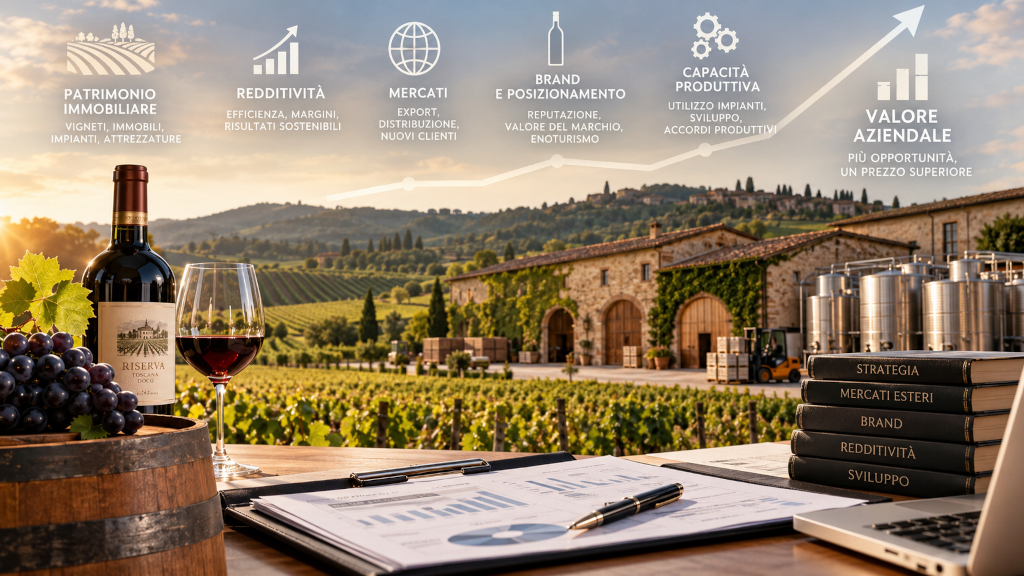
The real risk is not buying an expensive cellar, but buying it without knowing its value.
Two wineries with the same vineyard area and the same turnover can have profoundly different values.
The former may have good profitability, a diversified customer portfolio, and efficient production facilities.
The second may have excessive warehouses, significant debts, facilities in need of renovation and an insufficient sales network.
The difference doesn't necessarily emerge from a property visit or a sales presentation.
For an industrial investor, value can also derive from synergies with existing assets: production capacity, access to new names, expanded distribution, or supply chain integration.
It is therefore important to distinguish the company's market value from the strategic value that the same company may have for a specific buyer.
FORBUS's role in wine acquisitions
FORBUS supports entrepreneurs, industrial groups, private investors, and family offices in the search, evaluation, and acquisition of Italian wineries and wineries.
Our approach starts from one principle: an acquisition must have an industrial, commercial, and economic rationale, not just a financial one.
The FORBUS team is involved in selecting opportunities, conducting preliminary analysis, conducting economic and strategic evaluations, executing the transaction, and coordinating the professionals responsible for conducting specialized assessments.
The goal is to accompany the investor from the initial analysis to negotiation and, when the transaction meets the necessary conditions, to closing.
It's not just about finding a winery for sale, but also about understanding whether that business is truly suited to the buyer's project, what risks it entails, and what results it can generate over time.
Are you considering purchasing a winery?
Before signing a letter of intent, consult with professionals who know the wine sector, its production dynamics, and its commercial challenges.
FORBUS can help you assess an opportunity, identify key risks, and establish a structured and confidential acquisition path.
Request support for an acquisition with FORBUS | Strategic Business Advisory – Acquisitions, development, and business development. https://www.forbus.it/?utm_source=chatgpt.com