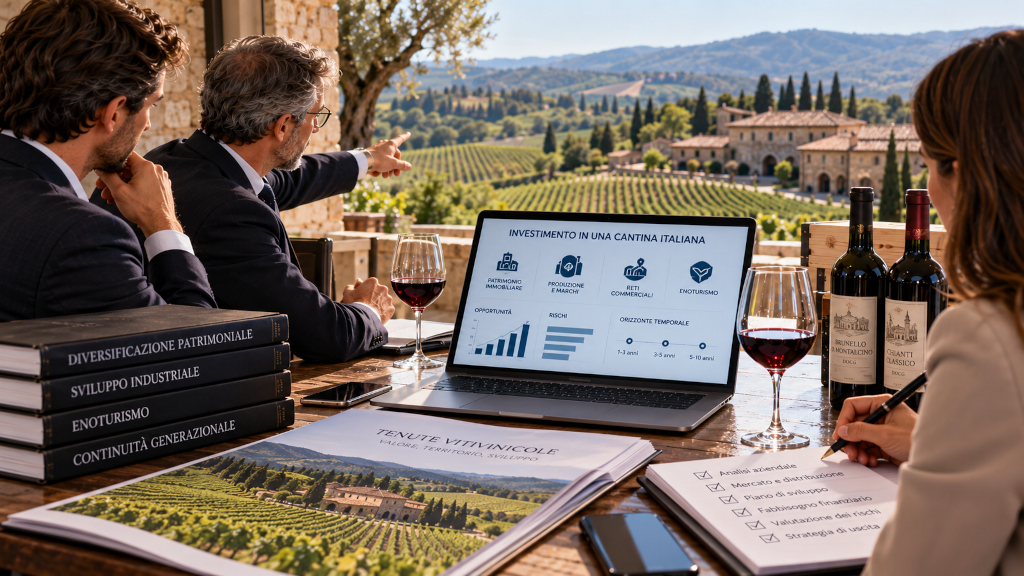
The Italian wine sector presents characteristics that may interest family offices, private investors, and wealth groups seeking medium- to long-term investments.
The presence of internationally recognized territories, prestigious denominations, historic agricultural properties, and consolidated brands offers opportunities that combine real estate, productive activities, and commercial potential.
However, buying a winery isn't simply the same as purchasing land and real estate. It means entering an agricultural and industrial enterprise, subject to climate, commercial, financial, and management risks.
For this reason, a wine investment should begin with a strategic analysis capable of assessing not only a property's value today, but above all its potential value tomorrow.
1. Why family offices are looking at Italian wineries
A winery can meet different investment objectives.
Asset diversification. Agricultural land, buildings, production facilities, and brands represent assets with different characteristics than traditional financial instruments.
Long-term heritage preservation. Properties located in recognized wine-producing areas can offer the prospect of long-term value creation, although they cannot guarantee price stability.
Industrial and commercial development. A winery with unused production capacity, limited distribution, or an under-recognized brand may offer real growth opportunities.
Generational continuity. Some investors view wine estates as assets to be developed and passed on to future generations.
Business diversification. Wine tourism, hospitality, direct sales, and local experiences can contribute to overall profitability when supported by a sustainable project.
The key is to identify properties that are consistent with the investor's financial and wealth objectives.
2. Which winery to buy? Four investment models
Not all wineries have the same characteristics. It's important to distinguish between real estate assets and industrial and commercial activities.
|
Typology |
Opportunity |
Main risk |
|
Estate with vineyards and buildings |
Long-term asset valorization |
High fixed capital |
|
Production and commercial cellar |
Operating profitability and market development |
Margins, distribution and management |
|
Company to be relaunched |
Value acquisition and recovery |
Additional investments and recovery times |
|
Winery with hospitality and wine tourism |
Revenue diversification |
Management costs and seasonality |
For a family office focused on asset preservation, an estate with quality land and valuable properties may be more attractive.
For an investor seeking operational returns, however, an already organized winery with recognized brands, established customers, and the potential for commercial expansion may be more attractive.
3. Time horizon: wine requires patience and planning
A wine investment can hardly be evaluated with an exclusively speculative logic.
The time required to develop vineyards, improve commercial positioning, enter new markets, or enhance a brand can be significant.
As a guideline, three horizons can be considered when building an industrial plan:
These are not guaranteed times, but rather guidelines that should be adapted to the company's specific situation.
A family office must therefore evaluate in advance the duration of the investment, the financial needs and the possible exit options.
4. How much capital is really needed?
One of the most common mistakes is to consider the acquisition price as the overall investment.
In reality, the required capital may include:
A cellar purchased at seemingly convenient conditions can become an expensive investment when financial needs arise that were not initially considered.
The true cost of an acquisition is the capital required to purchase, sustain, and grow the business until it achieves its intended goals.
5. Governance: Who manages the winery after the acquisition?
This is one of the most important aspects for a family office.
The investor may have the necessary financial resources, but not necessarily the skills to manage a winery.
A winery requires agronomic, oenological, industrial, commercial and financial knowledge.
It is therefore necessary to define before the acquisition:
Clear governance reduces the risk of an asset investment turning into a complex and difficult-to-control business.
For this reason, FORBUS offers an approach that can include, in addition to acquisition, the reorganization and development of the company through coordinated professional skills.
6. Expected returns: distinguishing between equity and profitability
The return on a wine investment can derive from three different components.
Operating performance: profits and cash flows generated by production and sales activities.
Asset enhancement: potential increase in the value of vineyards, buildings, plants, and other company assets.
Industrial valorization: increasing company value through improved margins, stronger brands, new markets, and greater efficiency.
These components must be evaluated separately.
A highly prestigious property may have high real estate value, but limited industrial profitability.
Conversely, a lesser-known winery can generate interesting economic results thanks to an efficient production structure and a consolidated sales network.
To evaluate the expected return, it is necessary to construct financial scenarios that consider initial investments, working capital, cash flows, debt, taxes, and exit value.
There is no standard return for Italian wineries that applies to all investments. Each transaction requires a specific assessment.
7. The main risks of investing in wine
Climate and agricultural risk
Drought, frost, hail, vine diseases and yield variations can affect production, quality and costs.
Commercial risk
Changes in consumption, price pressure, customer concentration, and export difficulties can reduce profitability.
Financial risk
Large inventories, long collection times, and ongoing investments can absorb liquidity.
Regulatory and authorization risk
Agricultural, urban planning, environmental constraints, production authorizations, and denomination specifications require thorough checks.
Management and liquidity risk of the investment
Dependence on the outgoing entrepreneur, a lack of managerial skills, and difficulty in quickly reselling the company can compromise results.
Adequate due diligence must therefore include patrimonial, economic, financial, legal, agronomic, industrial and commercial aspects.
8. How FORBUS supports family offices and investors
FORBUS operates in the wine sector with an approach that integrates company knowledge, strategic assessment, and investment support.
The goal is not simply to identify a winery for sale, but to verify whether it represents an investment consistent with the buyer's expectations.
The process can include six phases:
Definition of available capital, time horizon, expected return, and risk appetite.
Confidential search for wineries, wineries, vineyards, and industrial projects that match the investor's profile.
Analysis of assets, profitability, production potential, and investment needs.
Coordination of legal, tax, technical, and financial professionals involved in the transaction.
Support in defining the transaction structure, financial terms, and the process leading up to closing.
Possible support in governance, asset valorization, and industrial and commercial growth.
Direct knowledge of the sector allows us to consider elements that a purely real estate or financial evaluation might not capture.
9. It is not always necessary to buy 100% of the company
For a family office, there may be investment options other than full acquisition.
These include acquiring a majority or minority stake in the company, providing financial support to an existing entrepreneur, establishing dedicated companies, and gradually acquiring shares.
These structures can help spread financial commitment and maintain operational expertise already present in the company.
However, they require clear agreements on governance, shareholder rights, profit distribution, future capital increases, and exit procedures.
The choice must be made on a case-by-case basis with the support of competent professionals.
Conclusion: value comes from the quality of the operation
Italy's winemaking heritage can offer exciting opportunities to family offices seeking solid investments, long-term prospects, and entrepreneurial development opportunities.
But the prestige of a denomination, the beauty of an estate, or the notoriety of a brand are not enough to guarantee the quality of an investment.
The difference comes from the ability to purchase at the right value, understand the risks, define effective governance and develop a sustainable business plan.
A winery can be an asset to be preserved, a business to be grown, or both. The important thing is to know what investment you're actually making.
FORBUS | Reserved wine investments
FORBUS supports family offices, private investors, industrial groups, and Italian and foreign entrepreneurs in the research, evaluation, acquisition, and development of wineries and wineries.
Opportunities are examined based on the investor's objectives, with attention to confidentiality and the economic sustainability of the transactions.
Are you considering investing in the Italian wine sector?
Request a private meeting to discuss your goals and discuss available opportunities.
FORBUS – Strategic Business Advisory: Transactions, not announcements. Where deals start.
31/10/2026
29/10/2026

28/10/2026
27/10/2026