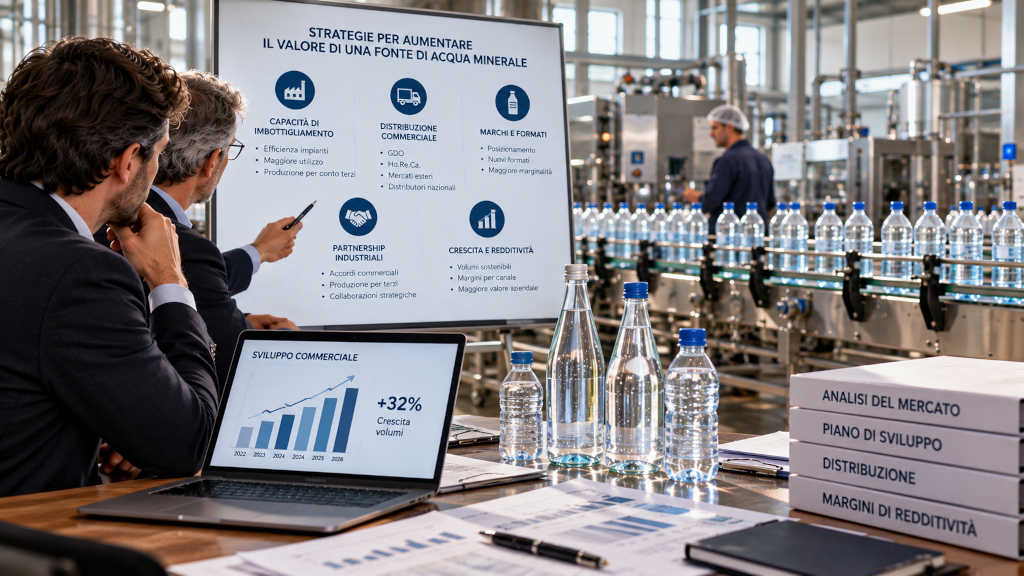
In Italy, there are companies that have concessions, bottling plants, production facilities, and commercial brands, but they are unable to fully express their value.
The reasons could be various: unused production capacity, limited distribution, commercial difficulties, insufficient investment or lack of a development strategy.
In these situations, selling is not necessarily the best solution .
Before considering a sale, the owner should ask himself how much his company could be worth through more effective industrial and commercial management.
1. The mineral spring: a heritage to be valorized
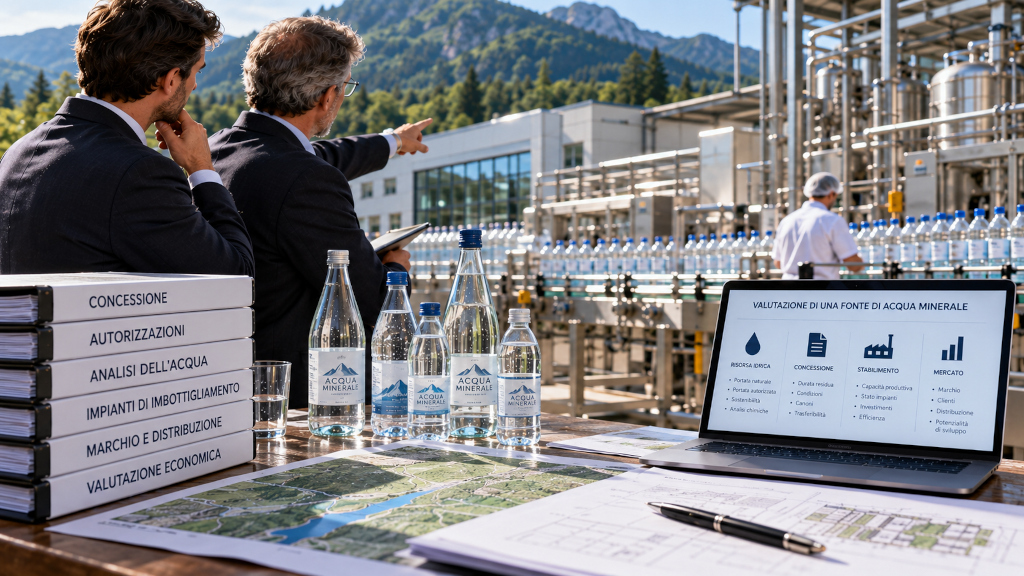
The value of a mineral water company does not depend solely on the quality of the water or the availability of the source.
It is the result of several elements that must be analyzed together:
A source with good water availability, but modest marketed volumes, could have unexplored potential.
The first operation to be carried out is therefore to distinguish the current value of the company from the value that it could achieve through a sustainable industrial project .
2. Bottling capacity: produce better before investing more
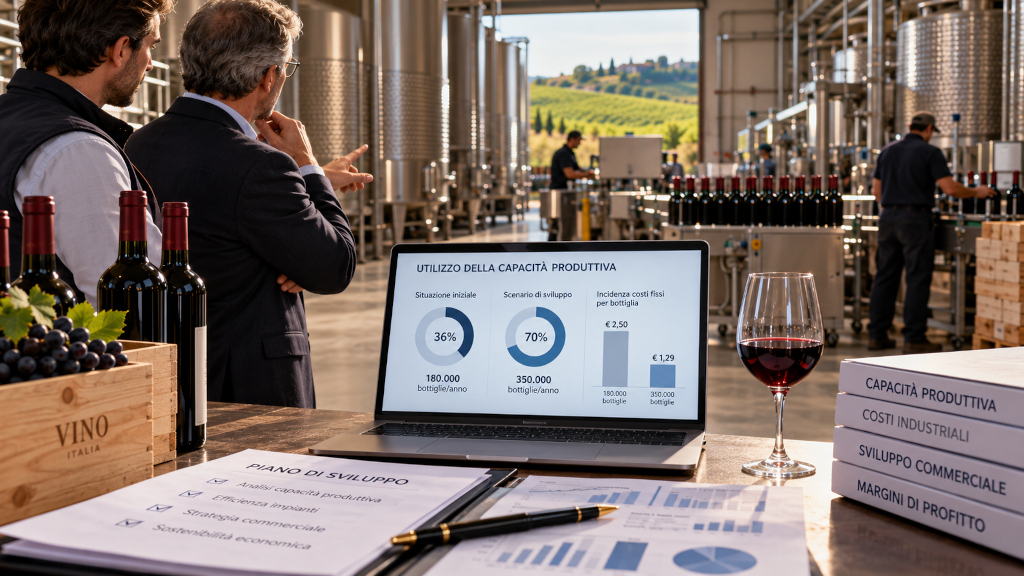
One of the first aspects to examine is the relationship between plant capacity and actual production.
A plant designed to bottle several million bottles a year may be operating well below capacity.
This situation entails fixed costs that have a significant impact on the unit cost of the product.
Before purchasing new machinery, it may be more cost-effective to improve production organization, line efficiency, and the use of existing facilities.
Possibilities include increasing production shifts, optimizing format changeovers, and, when technically and economically feasible, contract manufacturing.
The goal is not simply to bottle more water, but to obtain better margins from each liter marketed.
3. Commercial distribution: the real engine of growth
Even a top-quality mineral water can encounter difficulties if it does not have an adequate marketing organization.
Distribution is often one of the main factors determining company growth.
It is necessary to evaluate the channels in which the product can be competitive:
Not all markets are suitable for all mineral waters.
Transportation, product weight, distance from consumer markets, and price positioning can profoundly impact profitability.
For this reason, business development must start with a concrete analysis of margins by channel, customer, and territory.
4. Brands and formats: increasing the commercial value of the product
The brand represents an important element in the valorization of a source.
A mineral water does not necessarily have to compete only on price.
Geographic origin, water characteristics, brand recognition, packaging, and target market can all contribute to building a different positioning.
The choice of formats is also strategic.
PET bottles, glass, formats intended for catering and packaging for specific commercial channels have different costs, investments and margins.
The introduction of a new format, however, must be supported by concrete commercial demand.
Expanding your range without a distribution strategy can increase complexity and costs, rather than business value.
5. Industrial partnerships: growing while maintaining ownership
Not all companies independently have the financial, production and commercial resources necessary to develop.
In these cases, a partnership can represent an interesting alternative to selling.
Possible solutions include:
Each solution must be evaluated considering the required investments, expected margins, the duration of the agreements, and the entrepreneur's autonomy.
A well-structured partnership can help you increase revenue and profitability without having to sell the entire company.
6. Industrial management: when you need a project, not a buyer
Sometimes the main problem is not the quality of the source or the facilities, but the management of the company.
An estate can have significant assets without having an organization capable of developing them.
In these cases, it is possible to evaluate a multi-year management and enhancement project, with measurable objectives.
The program should include:
The goal is to build a stronger business, with greater revenue generation capacity and potentially higher asset value.
7. How much can the value of a mineral source increase?
There is no one-size-fits-all percentage.
The potential for valorization depends on the initial situation, the quality of the assets, the authorization constraints, the necessary investments and the ability to generate continuous economic results.
To understand this, it is necessary to develop an industrial plan that compares at least three situations:
Current situation: how much does the company produce, invoice, and earn today.
Development scenario: what results could be achieved by improving production, distribution, and sales organization?
Investment scenario: what resources are needed, how quickly they could be recovered, and what risks they entail.
Revenue growth alone does not guarantee increased company value.
True results are measured through operating profitability, cash generation, debt sustainability, and the ability to maintain results over time.
8. The FORBUS method: evaluate before deciding whether to sell
FORBUS supports owners of mineral water springs, bottling plants, beverage companies, and investors in evaluating industrial and commercial development projects.
The approach starts from one principle: before proposing a sale, it is necessary to understand whether the company can generate greater value through different management.
The work involves, depending on the needs of the operation, industrial, financial, commercial and strategic expertise, with the coordination of the necessary technical and legal specialists.
The goal is to identify concrete solutions, verify their feasibility, and support the owner through the subsequent operational phases.
A transfer remains an option, but it doesn't necessarily have to be the first choice.
Conclusion: a mineral source can be worth more than what it produces today
Owning a mineral water source means having a regulated natural resource, often accompanied by facilities, permits, brands and commercial relationships built up over time.
But the potential value of this asset may be very different from current economic results.
For some owners, the best solution might be a sale. For others, an industrial partnership, a business reorganization, or a multi-year development program.
The choice must arise from an independent analysis and clear objectives.
Before selling a mineral water spring, it is worth understanding how much it could be worth by developing it.
We evaluate a development project
FORBUS is available to owners of mineral springs, bottling companies, and beverage operators for an initial, confidential assessment of development, management, and industrial valorization opportunities.
Contact FORBUS and tell us about your business.
FORBUS – Experience, strategic vision, and operational expertise to enhance businesses.
29/10/2026

28/10/2026
27/10/2026

26/10/2026