Turnover is growing, but how much does the winery really earn?
In the Italian wine industry, revenue is often considered the primary indicator of a company's health. Selling more bottles, acquiring new distributors, entering foreign markets, and increasing production volumes are important objectives.
But there is an even more crucial question: how much economic value actually remains for the winery after having sustained all the costs necessary to produce and sell the wine?
Commercial growth not accompanied by adequate margin control can produce unexpected consequences: higher industrial costs, larger inventories, increasing trade receivables and a growing need for financing.
This situation can affect both small family-run wineries and established wineries, especially when the sales strategy prioritizes volume over profitability.
For this reason, FORBUS considers economic and financial analysis one of the fundamental steps in any business development and valorization project.
1. Not all bottles produce the same margin
A winery can market wines with very different economic characteristics: bulk wines, own-brand products, private labels, DOC and DOCG wines, sparkling wines, reserves and premium selections.
Each category has different prices, costs, volumes and commercial conditions.
A wine sold for 4 euros can contribute more to the economic result than one sold for 8 euros, if the latter involves much higher production, packaging, promotion and distribution costs.
The analysis must therefore identify:
The point is not necessarily to eliminate the least profitable products, but to understand what function they play in the overall balance of the company.
2. Prices and commercial channels: selling more does not mean earning more
The same bottle can produce very different economic results depending on the sales channel.
Large-scale distribution, Ho.Re.Ca., importers, foreign distributors, direct sales, and wine tourism require different cost structures.
For example, a contract with a major distributor may guarantee high volumes, but require discounts, promotional contributions, payment deferrals, and demanding logistical conditions.
Direct selling can allow for a higher unit price, but requires commercial investment, personnel, communication and customer management.
To correctly evaluate channels, it is therefore necessary to consider the net margin of costs directly attributable to the channel, not just the selling price.
An effective commercial strategy must find the right balance between volumes, prices, order continuity, and the ability to generate liquidity.
3. Production costs: where margins are lost without realizing it
In a winery, many costs can grow progressively without being immediately noticed.
These include the cost of grapes, winemaking processes, energy, glass, corks, labels, packaging, personnel, maintenance, and product handling.
Added to these are the depreciation of plants and structures.
A common problem concerns unused production capacity: a winery sized to produce a million bottles that sells only 400,000 still has to cover a significant portion of its fixed costs.
In these cases, before investing in new facilities or increasing production, it is necessary to evaluate how much can be recovered through improved industrial organization, new orders, or production agreements.
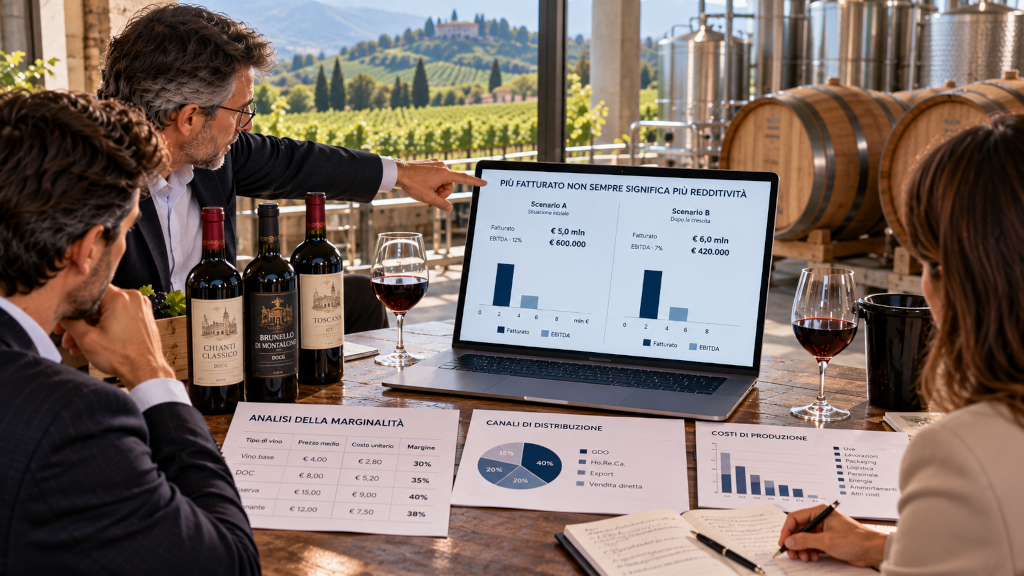
4. A numerical example: higher turnover, lower profitability
Let's consider a hypothetical winery that decides to increase sales through new distributors and a more aggressive sales policy.
This simulation is for illustrative purposes only and does not refer to a real company. Amounts shown exclude VAT.
Scenario A · Initial situation
€5.0 million
Sales
€600,000
EBITDA · 12%
Scenario B · After growth
€6.0 million
Sales
€420,000
EBITDA · 7%
Comparison between turnover and EBITDA
Values in millions of euros, illustrative simulation
Sales
EBITDA
0 million €2 million €4 million €6 million €8 million €Scenario AScenario B
|
Indicator |
Scenario A |
Scenario B |
|
Sales |
€5,000,000 |
€6,000,000 |
|
Operating costs* |
€4,400,000 |
€5,580,000 |
|
EBITDA |
€600,000 |
€420,000 |
|
EBITDA margin |
12% |
7% |
* Operating costs excluding depreciation, interest and taxes, according to the simulation assumptions.
The result is significant: turnover increases by 20%, but EBITDA decreases by 30%.
The winery sells more, but the increase in costs outweighs the economic benefit of the new sales.
This example demonstrates why a strategy based solely on increasing volume can undermine company profitability.
5. Working capital: the problem that often doesn't emerge from turnover
Another key issue concerns liquidity.
In the wine industry, the time between purchasing or producing grapes and receiving proceeds from the bottles sold can be particularly long.
The maturation of wines, the refinement, the stocks of finished products and the extensions granted to customers tie up financial resources.
A rapidly growing winery may therefore find itself in the paradoxical situation of increasing its turnover and simultaneously requiring greater bank financing.
For this reason, it is necessary to monitor three fundamental indicators: average warehouse holding days, collection times from customers, and payment times to suppliers.
Profitability measures financial performance. Liquidity measures the ability to effectively sustain the business. The two metrics must be analyzed together.
6. How FORBUS intervenes to improve the profitability of a winery
The FORBUS approach starts from one principle: before proposing new investments, new markets, or increased production, it is necessary to understand where the company generates value and where it loses it.
The work can be developed through five connected interventions.
Economic and industrial analysis
Reconstruction of margins by product, line, customer, and channel, with verification of fixed and variable costs.
Wine portfolio optimization
Evaluation of the production and commercial mix, prices and repositioning opportunities.
Improving production efficiency
Analysis of plant utilization, processing costs, and potential industrial savings.
Financial management and working capital
Inventory control, receivables, payables, cash flow and financial requirements.
Development and enhancement plan
Definition of measurable economic objectives and coordination of production, commercial, and financial interventions.
The goal is not to simply deliver an analysis, but to support company ownership and management in implementing decisions, involving the necessary specialized skills.
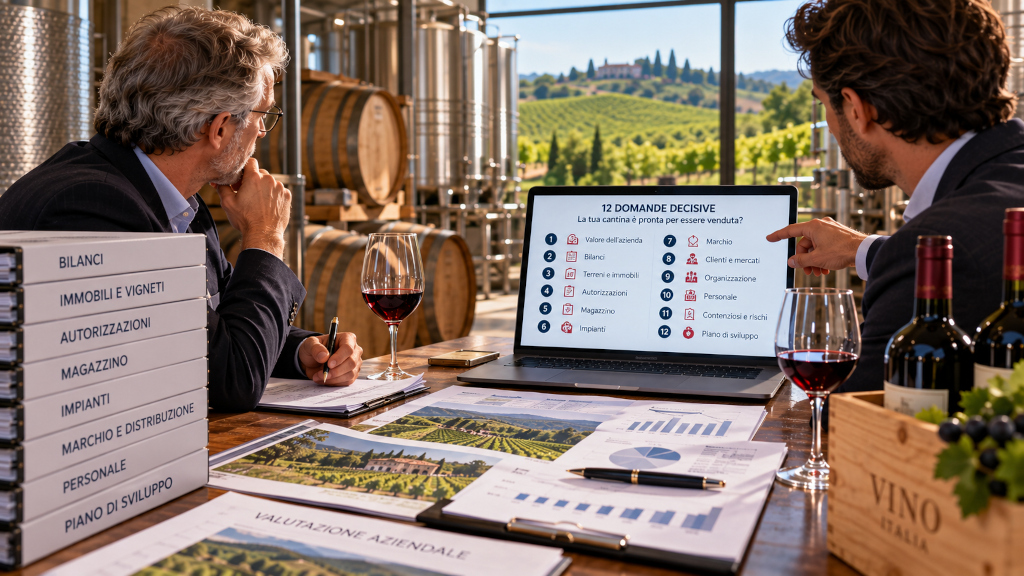
7. A more profitable winery is also a more attractive enterprise for investors.
Margins don't just affect day-to-day management. They can directly impact the company's value in the event of a sale, acquisition, or the entry of new shareholders.
A qualified investor doesn't just evaluate revenue or real estate assets. They analyze the company's ability to produce sustainable financial results, generate cash flow, and finance its growth.
A winery with lower revenue but solid margins, diversified customers, sustainable debt, and efficient production processes may be more attractive than a larger but less profitable company.
The actual value will naturally also depend on the vineyards, properties, brands, commercial location, required investments and market conditions.
For this reason, improving margins before starting a sale can represent an important opportunity for company valorization.
Conclusion: the future of a winery is built on margins, not just on sales.
The wine market requires companies to have an ever-increasing ability to control costs, prices, commercial channels, and financial resources.
Increasing turnover remains an important goal, but it cannot be the only parameter for measuring a winery's success.
True growth occurs when a company can transform sales into adequate margins, liquidity, and investment capacity.
A winery that knows its numbers can choose how to grow. A winery that only focuses on revenue risks growing without creating value.
FORBUS | We analyze your winery's margins
Is your winery increasing sales, but the bottom line isn't improving? Or does it have production and marketing capabilities that could be leveraged?
FORBUS supports owners, entrepreneurs, and winemaking groups in analyzing profitability, improving financial results, and developing business value.
From analysis to implementation, with a single team of professionals and shared goals.
www.forbus.it — Request a confidential consultation on your winery's profitability.