By FORBUS | Strategic Business Advisory – Wine Sector
Selling a cellar is not always the best choice
The Italian wine sector is characterized by thousands of family businesses that preserve vineyards, cellars, properties, brands, and traditions built over generations.
Many of these entities have significant assets, but are not always able to fully exploit their economic and commercial potential.
The difficulties can be varied: lack of generational turnover, increasing management costs, insufficient margins, difficulties in exporting, unused production capacity, or the lack of an adequate management structure.
Faced with these situations, owners often tend to consider two alternatives: continuing to directly manage the company or selling it.
However, there is a third option: entrusting management to a professional organization through a multi-year agreement, while retaining ownership of the company.
It is on this principle that FORBUS proposes a model for managing and enhancing wineries.
How does multi-year cellar management work?
The model provides for the owner to retain ownership of the company, while a team of professionals assumes, within contractually established limits, operational and management responsibilities aimed at achieving agreed-upon objectives.
It's not simply a matter of outsourcing some tasks to external consultants.
The goal is to build a true industrial and commercial project, with defined responsibilities, investment programs, economic indicators, and periodic performance reviews.
An agreement may have an indicative duration of 10–15 years, to be defined in relation to the characteristics of the company, the necessary investments and the objectives of the owners.
This horizon allows for the planning of interventions that are unlikely to produce significant results in the short term.
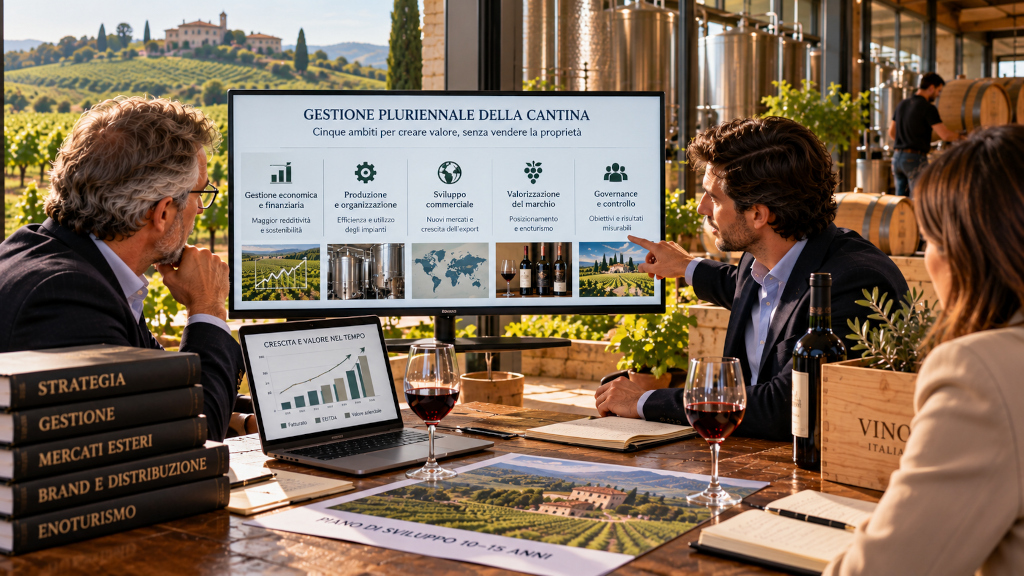
The five areas of professional management
1. Economic and financial management
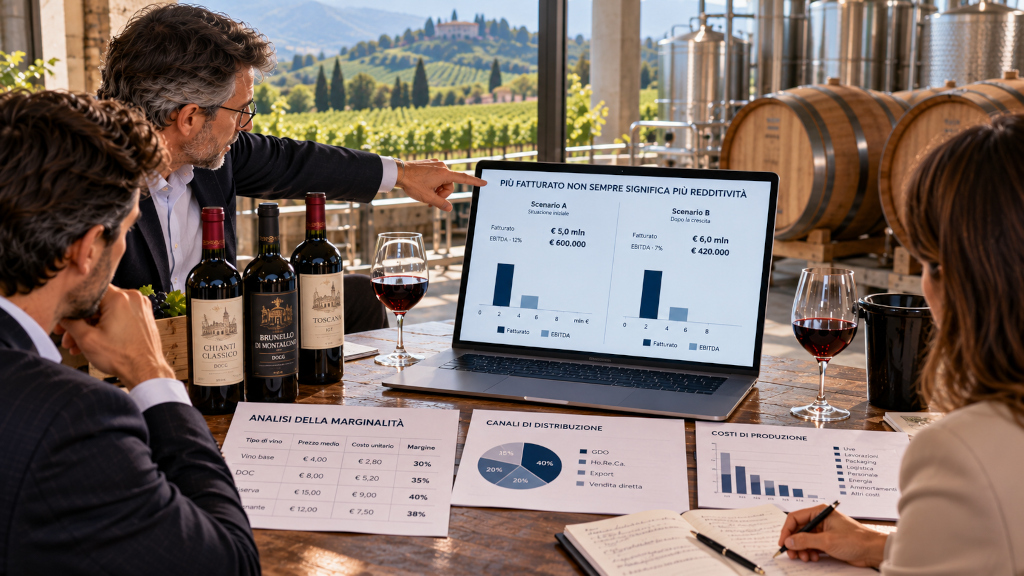
Analysis of production costs, product margins, cash flows, working capital, and investment sustainability. The goal is to improve profitability, not simply increase revenue.
2. Production and organization of the cellar
Monitoring plant utilization, production planning, inventory management, staff organization, and coordination of technical and winemaking skills.
3. Business development and foreign markets
Definition of priority markets, selection of distributors, review of the product portfolio, pricing policies and development of long-lasting commercial relationships.
4. Brand and heritage enhancement
Improving the positioning of wines, enhancing vineyards and properties, and developing potential wine tourism, hospitality, and direct sales activities.
5. Governance and monitoring of results
Definition of responsibilities, annual budgets, periodic reports, measurable objectives and control procedures shared with the management.
The principle is simple: every intervention must contribute to creating verifiable economic, commercial, or patrimonial value.
Ownership and management: two distinct roles
One of the most important aspects of the model is the separation between ownership and operational responsibilities.
|
The property |
The professional manager |
|
Maintains ownership of the business |
Coordinates the assigned activities |
|
Approves confidential strategic decisions |
Implement the agreed industrial plan |
|
Defines capital objectives |
Organizes production and business development |
|
Check results and investments |
Prepares budgets and reports |
|
You retain the rights provided for in the agreement |
Responsible for contractual objectives and obligations |
The actual distribution of powers depends on the legal form of the agreement. Professional management does not automatically entail the transfer of corporate responsibilities or legal obligations.
How the economic agreement can be structured
There is no one-size-fits-all contract for all wineries.
The relationship can be organized through different formulas, to be defined with the support of legal and tax professionals based on the company structure.
In the multi-year management model proposed by FORBUS, a possible economic approach could include:
It is essential to distinguish between the owner's compensation and that of the manager, define who bears the operational risks, and clearly establish how results are calculated.
Revenue growth alone does not guarantee improved company value. Therefore, agreements must also consider margins, liquidity, debt, and investments.
A concrete example: a cellar with untapped potential
Let's consider, for illustrative purposes only, a winery with these characteristics:
HYPOTHETICAL SIMULATION – INITIAL SITUATION
Annual turnover
€1.2 million
Production capacity
300,000
bottles/year
Actual production
150,000
bottles/year
Capacity utilization
50%
Project objective
Progressively improve plant utilization, develop new markets, increase margins, and strengthen brand value.
A multi-year plan could include a gradual increase in volumes, an improvement in the sales mix, and greater production efficiency.
Actual results, however, would depend on market demand, commercial capacity, investments and the company's economic and financial conditions.
The goal would not be to produce more bottles at any cost, but to generate greater profitability and value through sustainable growth.
When is it worth considering multi-year management?
This solution can be particularly interesting for:
However, not all cellars are suitable for this model.
The sustainability of the agreement must be verified through a preliminary analysis of the balance sheets, assets, debt, production structure, business prospects, and capital requirements.
The FORBUS method: from evaluation to management
FORBUS approaches these projects through a multidisciplinary team that integrates economic-financial, production, commercial, technical, and strategic skills.
The journey develops through four main moments.
Preliminary analysis
Examination of the company's situation, assets, financial results, and untapped potential.
Enhancement plan
Definition of the interventions, the necessary investments, the expected results and the implementation timeframe.
Multi-year agreement
Identification of the contractual formula, responsibilities, compensation and control systems.
Management and monitoring
Project implementation, coordination of skills, and periodic review of objectives.
The value of a cellar does not depend only on how much it is worth today
A winery property is not just made up of hectares of vineyards, buildings, machinery and bottles in storage.
Its value also depends on its ability to generate income over time, its commercial strength, the quality of the organization, and its development prospects.
A winery that is unprofitable today may have significant resources that are not being adequately utilized.
In these situations, professional management can represent a concrete alternative to an immediate sale, provided that sustainable industrial and financial conditions exist.
Selling a winery means transferring ownership. Managing it professionally can mean preserving it and creating the conditions to increase its value over time.
This is the perspective from which FORBUS supports entrepreneurs and owners in evaluating alternatives for the future of their companies.
Could your cellar be worth more without being sold?
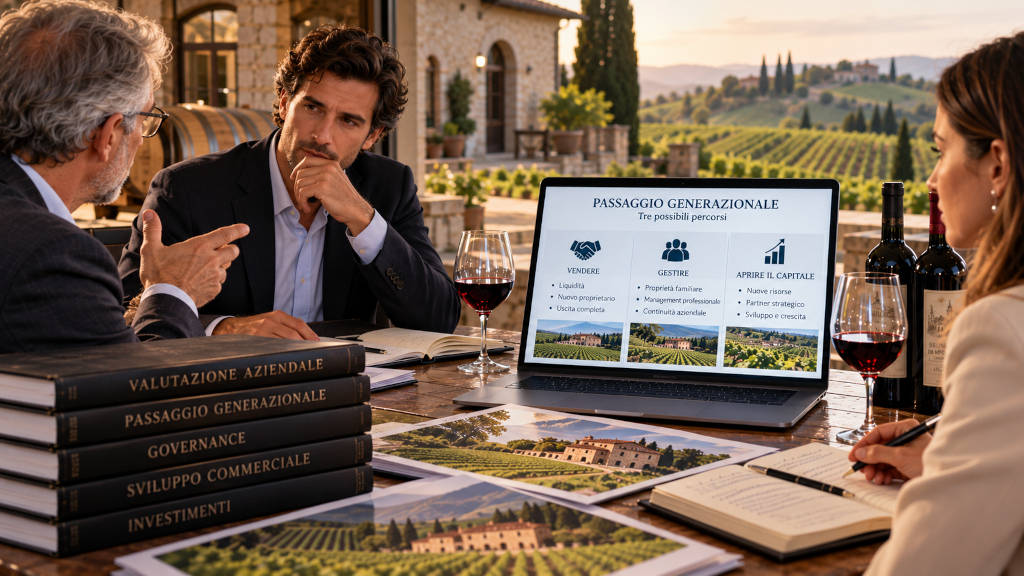
If you own a winery and want to reduce your operational effort, improve results, or manage a generational transition, FORBUS can work with you to evaluate the possibility of developing a multi-year management plan.
The first step is a confidential meeting to understand the company's characteristics and determine whether the conditions exist for a development process.
Explore a management project with FORBUS
FORBUS – Strategic Business Advisory One team, one project, shared goals.
07/11/2026
06/11/2026
05/11/2026
04/11/2026