Generations of entrepreneurs have invested in vineyards, cellars, land, systems, brands, and commercial relationships, building assets that represent much more than their economic value.
Today, however, many owners are faced with a difficult question: what will happen to the company when the current owner is no longer able or willing to run it?
Children don't always want to continue the business. Sometimes they live abroad, have other jobs, or lack the skills needed to manage an increasingly complex winemaking enterprise.
In other cases, however, successors exist and are interested, but the company needs capital, managerial skills, and new business strategies.
Generational transition doesn't necessarily have to end with the sale of the winery. It can be an opportunity to rethink management, strengthen the business, and enhance the family's assets.
1. Selling your cellar: a decision to prepare for, not to endure
Selling a business may be the most appropriate solution when the family no longer intends to continue the business or wishes to convert the company's assets into liquidity.
But selling a winery means transferring a complex set of assets: vineyards, buildings, equipment, warehouse, brands, customers, permits, organization, and revenue-generating capacity.
A transfer undertaken under urgent conditions risks reducing the owner's negotiating power.
For this reason, it is important to prepare for the operation by analyzing the financial, economic, production, and commercial situation beforehand.
The fundamental question is not only how much the winery is worth today, but how much it could be worth after an appropriate valorization process.
2. Entrust the management to professionals without selling the property
One of the most attractive alternatives is to retain ownership of the company, entrusting its operational management to a group of specialized professionals.
This solution may be particularly suitable for families who wish to preserve their vineyards, properties, and brand, but no longer intend to directly manage them on a day-to-day basis.
A professional management project can address various aspects:
The owners can thus maintain a leadership and control role, entrusting operational activities to specific skills.
Naturally, responsibilities, objectives, duration, decision-making powers, compensation, and tools for assessing results must be precisely defined.
Retaining ownership does not necessarily mean continuing to personally manage the business.
3. Open the capital to an investing partner
Another possibility is for an industrial or financial investor to participate through a corporate stake.
The transaction could allow the family to retain a stake in the company, while simultaneously acquiring new resources to finance development.
The partner can contribute capital, industrial expertise, commercial organization, access to international markets, or distribution capacity.
There are various possible solutions: the entry of a minority shareholder, the acquisition of a majority stake, or the creation of a new corporate structure to develop specific activities.
The choice must be accompanied by clear agreements on governance, investments, profit distribution, transfer of shareholdings, and possible exit modalities.
A particularly important aspect concerns the allocation of resources: the purchase of existing shares generates liquidity for the selling shareholders, while a capital increase brings new financial resources to the company.
They are two operations with very different effects.
4. Sell gradually, accompanying the new entrepreneur
Not all transfers have to happen at once.
In certain situations, it is possible to foresee a gradual entry of the buyer, with the initial transfer of a share and the subsequent acquisition of the remaining shares.
This model allows the outgoing entrepreneur to support the new partner, transferring knowledge, business relationships, and skills developed over the years.
This can be an interesting solution, especially when the company's value still depends heavily on the presence of the founder.
However, it is essential to define the timeframes, financial conditions, criteria for determining future prices, guarantees and responsibilities from the outset.
Gradualness must be a tool for continuity, not a source of uncertainty.
5. Reorganize family governance
Sometimes the problem is not the lack of successors, but the lack of a clear organization between ownership and management.
A family can own a winery even without all its members participating in the business.
It is necessary to distinguish the role of the members from that of the directors and operational managers.
Appropriate governance may include external directors, management delegations, shared rules among shareholders, control tools, and investment planning.
When there are multiple heirs, it is particularly important to prevent conflicts over strategic decisions, profit distribution, and future prospects.
Succession, corporate, and tax matters must be thoroughly discussed with qualified professionals, taking into account the company's structure and family situation.
6. Which solution to choose? It depends on the company and the family's goals.
There is no one-size-fits-all answer for all wineries.
A property with premium vineyards, a recognized brand, and an efficient production facility may have different opportunities than a company with unused production capacity, commercial problems, or the need for new investments.
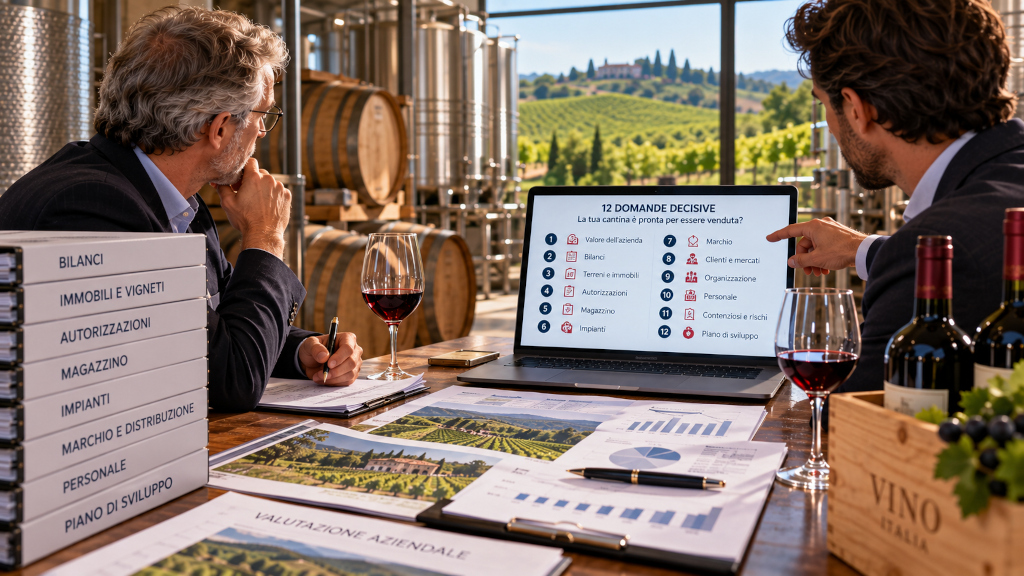
Before making a decision, it is useful to answer some fundamental questions:
The answers allow us to identify a path consistent with our financial, family, and business objectives.
7. The role of FORBUS: building a concrete alternative
FORBUS was created to support winery owners, wineries, and investors in decisions that affect the future of their businesses.
Our approach does not start from selling as the only solution, but from analyzing the company's real potential.
Through a multidisciplinary team, FORBUS can support the owner in evaluating alternatives:
Pre-sale valuation. Identify actions that can improve profitability and enhance the company's value.
Professional management. Structure continuity and development projects, maintaining family ownership.
Search for partners and investors. Identify industrial or financial partners who match the company's characteristics and objectives.
Full or gradual transfer. Prepare and oversee the transaction, coordinating the necessary professional skills until completion.
The goal is to help entrepreneurs make informed decisions, without being forced to make decisions under time pressure or business challenges.
Conclusion: generational transition can become a new opportunity
A cellar built over decades of work deserves a decision that looks beyond the immediate.
Selling can be the right thing to do. Opening up capital can accelerate development. Entrusting management to professionals can ensure continuity and enhance the value of your assets.
The difference lies in knowing the alternatives before choosing.
The real risk isn't the generational transition. It's addressing it too late, when the options have already diminished.
FORBUS | We evaluate alternatives for your company
If you own a winery or winery and are considering its future, we can discuss possible solutions together.
An initial, confidential meeting can help you understand whether it's best to sell, open up capital, outsource management, or begin a value-enhancement process.
FORBUS – Strategic Business Advisory
Experience, strategic vision, and skills to support companies in important decisions.
Contact us at www.forbus.it to discuss alternatives for your company.
06/11/2026
05/11/2026
04/11/2026

03/11/2026