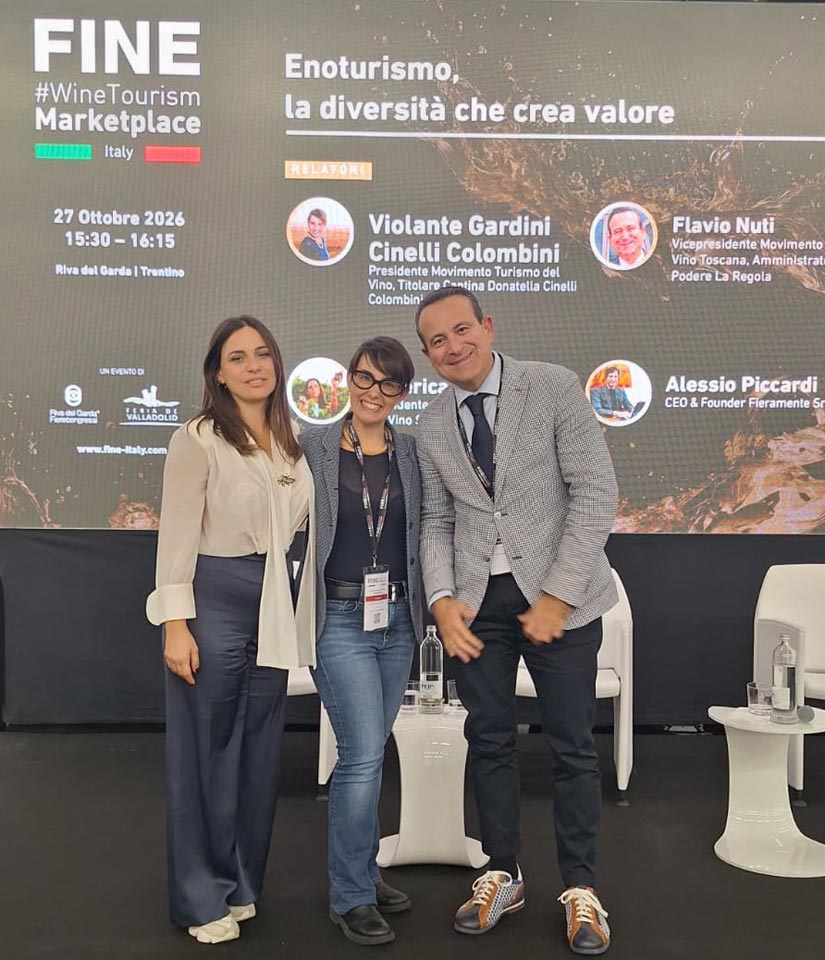
There is no single model for wine tourism: the hospitality methods and experiences offered by each winery reflect the characteristics and peculiarities of their local area.
The future of the sector hinges precisely on these differences, and understanding them allows us to develop actions tailored to each situation and capable of transforming wine into an experience that goes beyond tasting. From trends in tourist flows to challenges related to accessibility and sustainability, the survey conducted by CESEO (Centro Studi Enoturistici e Oleoturistici) - LUMSA on the wineries of the Wine Tourism Movement explores Tuscany and Sicily during FINE Italy, providing a comprehensive picture of the value of territorial diversity and the opportunities for developing wine tourism. Two regions that stand out for the high presence of foreign visitors to the winery ( 66% of the wineries with more than half of them being foreign wine tourists are in Tuscany and 74% in Sicily). Tuscan wineries have a leading and pioneering position but are also better able to manage relationships with those who market wine tourism (46% send proposals several times a year), while Sicilian wineries have a younger profile and are oriented towards sustainability and online relationships , proposing two different but complementary hospitality models: in Tuscan wineries, wine is intertwined with culture and the landscape, also demonstrating a great ability to interact with sector operators in the area (46% send proposals several times a year) , while in Sicilian wineries there is a marked attention to sustainability, with a wine tourism proposal that finds its distinctive traits in gastronomy and the warmth of a festive hospitality.
The research, presented on October 27 in Riva del Garda as part of FINE Italy, Italy's leading wine tourism trade show, highlights two successful models for their ability to make winery hospitality increasingly quality, accessible, and sustainable. Violante Gardini Cinelli Colombini, President of the Wine Tourism Movement and owner of Cantina Donatella Cinelli Colombini, presented the national data. Federica Fina, President of the Sicilian Wine Tourism Movement and owner of Cantine Fina, discussed the region's characteristics and the experiences she has developed with her own winery. Flavio Nuti, Vice President of the Tuscany Wine Tourism Movement and CEO of Cantina Podere La Regola, also spoke from Vinitaly NY. Finally, Alessio Piccardi, CEO & Founder of Fieramente Srl, presented an overview of the most recent data on Italian wine imports to the US, highlighting the trends and differences between different regions.
"This discussion stems from the idea of understanding wine tourism through regional differences ," explains Violante Gardini Cinelli Colombini, president of MTV. " These are important resources from which to identify new growth opportunities in terms of improving the offering, quality of hospitality, and the ability to meet sustainable development goals. As the Wine Tourism Movement, we believe that sharing experiences and expertise is essential to building a more informed and competitive sector. This allows us to jointly promote Italy's food and wine offerings, highlighting their regional diversity and uniqueness, and allowing each sector to grow in its own way, yet collaboratively with others."
The survey focused primarily on tourism demand, which confirms Tuscany as a consolidated destination , characterized by significant visitor flows and a structured sales network, as evidenced by 42.6% of local operators who market wine tours and 46.8% of wineries that send proposals to agencies several times a year. 40.4% of Tuscan wineries exceed 2,000 visitors, and for 2025, 46.8% report an increase in visitors, compared to 29.8% reporting a stable situation. These data reveal a solid profile that also benefits from a strong international presence, evidenced by the 66% reporting that foreigners account for more than half of their visitors.
Sicily, on the other hand, is experiencing a growing demand, accompanied by an evolution in supply throughout the region: 61.4% of wineries report an increase in visitors in 2025, and a full 59% say they have developed new wine tourism experiences for 2026. Furthermore, three-quarters of the companies report a predominantly foreign clientele, confirming the importance of the international component. However, in Sicilian wineries, tasting remains the cornerstone of the experience, with 37.6% offering food and beverages and only 23% offering overnight stays, indicating there is still room to expand stay options and enhance the experiential component of the visit. This trend is also reflected in the economics: for 58.3%, wine tourism revenue, excluding direct wine sales, represents less than 10% of the total.
Among the growth drivers, sustainability continues to play a central role : in the Sicilian sample, 86.7% of companies report producing energy from renewable sources, 88% do not use plastic in customer service, and 72% use lightweight glass bottles for their wines; 34.1% of companies also have charging stations for electric vehicles. Alongside this sustainable growth, the issue of accessibility remains unresolved : reaching a winery can still involve significant costs, according to 71% of Tuscan companies and 50% of Sicilian companies, who report costs exceeding €100 for transfers from the nearest airport. In Tuscany, 23% of companies offer organized transportation to the winery, and 62% report the possibility of tour buses, demonstrating a particular focus on improving the arrival at the winery. This requires improved information on transport connections and the development of agreements with tour operators. Federica Fina, President of the Sicilian Wine Tourism Movement, and Flavio Nuti, Vice President of the Tuscany Wine Tourism Movement, then spoke about the work carried out by regional associations and presented their business cases as examples of wine tourism.
The survey reveals that one of the key future challenges is increasing the value generated by each visit . This means moving beyond a logic based solely on visitor numbers and developing a broader offering, with complementary experiences in the vineyard and cellar that encourage visitors to linger longer and develop a lasting connection with the winery. In this sense, the comparison between the two regions offers insights for developing operational solutions that are adaptable and replicable in each region, addressing the visitor's arrival, stay, purchase, and return journeys. This helps guide wineries toward functional hospitality models that are still consistent with their size and potential. The research thus reveals two complementary trajectories: while the Tuscan model proves to be a consolidated destination with a significant influx of visitors, Sicilian wineries are characterized by a particularly dynamic offering.

16/10/2026

13/10/2026

12/10/2026

03/10/2026