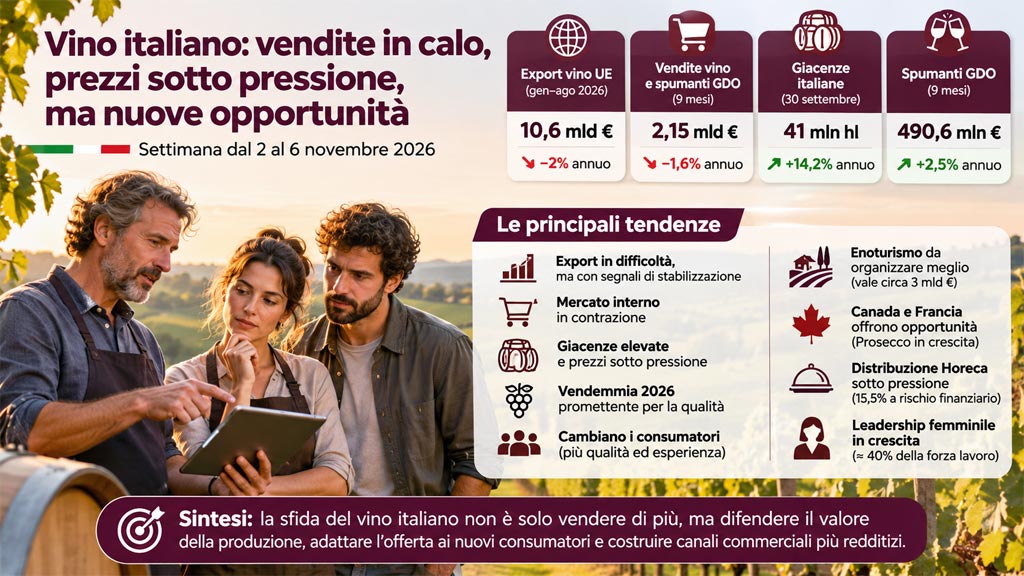
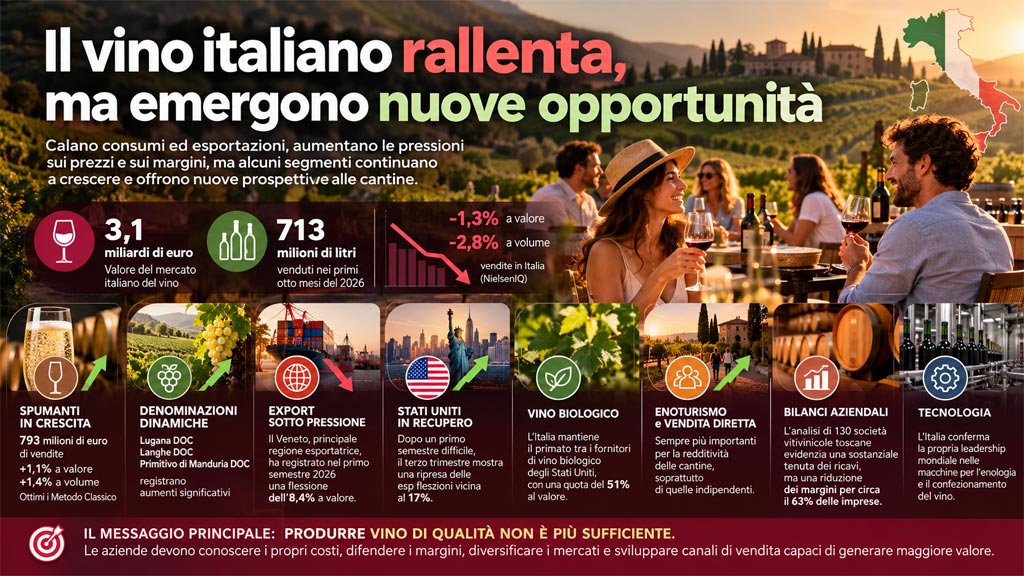
A comprehensive look at this week's news paints a picture of a two-speed industry. On the one hand, encouraging signs emerge from exports, Italian sparkling wines, and new international markets; on the other, structural challenges persist related to declining consumption, generational changes, corporate profitability, and the economic sustainability of production.
2027 promises to be a year of transformation in the production, commercial, and entrepreneurial balance of Italian wine.
1. Summary of the week – The main indicators
European Union wine exports
€12.1 billion
First nine months of 2026, substantial stability
Sparkling wines in Italian out-of-home dining
7%
January-September 2026
Export to 13 emerging markets
5.9%
First semester 2026
World wine production
225 million hl
Preliminary estimate OIV 2026
World wine consumption
221 million hl
Lows of the last decades
Piedmontese wine export
2.4%
566.9 million euros in the first half-year
Revenues of the 992 wineries analyzed
-2.8%
2025 Financial Statements – DiVino Management
Production of no- and low-alcohol wines
90%
Italian Forecast 2026 – UIV
2. The news of the week, summarized by topic
Exports: European wine recovers, Italy reduces losses
In the first nine months of 2026, European Union wine exports reached 12.1 billion euros, recovering from the decline recorded in previous months and essentially returning to 2025 levels.
Italian wine is also showing signs of improvement, especially in non-European markets. According to the UIV Observatory, the decline in non-EU exports went from 7.5% at the end of June to just over 2% at the end of September.
In the United States, according to the same survey, the decline is reduced from 14% to 5.5%.
Italian exports: recovery in the third quarter
Cumulative changes in value compared to 2025 – UIV
End of June
End of September
United States Outside the EU
The non-EU data for September is represented graphically with an indicative value.
The recovery is significant, but it doesn't yet represent a consolidated trend reversal. Tariffs, currency exchange rates, and international uncertainty continue to impact trade prospects.
Emerging markets: the need for diversification is growing
According to Nomisma's Wine Monitor, in the first half of 2026, Italian exports to 13 emerging countries grew by 5.9%.
The evolution of some markets over the decade 2015-2025 is particularly interesting.
Growth of Italian wine exports 2015-2025
Percentage change over the decade
Romania 507%
Turkey 325%
Vietnam 264%
World average 45%
Source: Nomisma – Wine Monitor, data reported in the review.
Brazil also performed well, with Italian sales growing by 6%. ICE Agency encourages companies to strengthen their presence in Mercosur markets, India, and Australia.
Geographic diversification is no longer just a business opportunity, but a tool for reducing corporate risk.
Sparkling wines: bubbles continue to drive the sector
Sparkling wines remain among the most dynamic categories in the Italian wine scene.
According to Circana, in the first nine months of 2026, the Italian out-of-home market generated approximately 58 billion euros in spending, with over 9.5 billion visits.
|
Indicator |
Variation |
|
Total spending outside the home |
1% |
|
Average receipt |
1.7% |
|
Visits |
-0.7% |
|
Consumption of alcoholic beverages |
-6.5% |
|
Sparkling wines and sparkling wines |
7% |
Sparkling wines account for 258 million purchases, driven primarily by aperitifs and social occasions.
Italian sparkling wines are also showing greater resilience on international markets, with growth of more than 4% in value in the first nine months according to UIV.
The Sparkle 2027 guide also confirms the high level of quality achieved by the main Italian denominations.
Sparkle Guide 2027 – Main Award-Winning Appellations
Number of awards with the 5 Spheres
07142128 Trentodoc Conegliano Valdobbi…Franciacorta Alta Langa
Italian dry sparkling wine production reached 1.113 billion bottles in the period from August 2025 to July 2026, with exports estimated at close to 2.4 billion euros.
Piedmont: a growth that goes against the trend
Piedmont returns to second place in Italy for the value of wine exports, overtaking Tuscany.
Regional Wine Exports – First Half of 2026
Piedmont Tuscany Veneto
Source: Italian Wine Union Observatory.
Piedmontese exports reached €566.9 million, a 2.4% increase. The performance of Asti Spumante DOCG was particularly significant, with exports exceeding €73 million, a growth of over 28%.
This result highlights the importance of commercial positioning, international promotion, and the ability to capture evolving consumer preferences.
World production and vineyard areas in decline
According to initial estimates from the OIV, world wine production in 2026 should reach between 220 and 230 million hectolitres, with a central forecast of 225 million.
Italy maintains its world production leadership.
World wine production 2026
Main producing countries – millions of hectolitres
Italy 41 million hl
France 36.5 million hl
United States 19 million hl
South Africa 11.3 million hl
Selection of countries for which the review provides quantitative data. Preliminary OIV estimates.
Since 2020, the global vineyard area has decreased by approximately 4.8%, due to climate change, abandonment, uprooting, and the need to adjust production to demand.
However, the contraction in production alone is not sufficient to resolve the imbalances between wine availability and consumption.
Global consumption: the problem is now structural
According to the Copa-Cogeca report cited in the review, world wine consumption fell to 221 million hectolitres, reaching the lowest levels in recent decades.
Red and rosé wines are particularly affected.
The new generations aren't completely replacing traditional consumers. In Germany, for example, 77% of wine is consumed by people over 55.
The main causes of this change are due to a greater focus on health, reduced spending power, evolving lifestyles, the complexity of the offering, and the reduced importance of wine during meals.
The sector must therefore rethink its relationship with consumers, through simpler communication, new consumption opportunities, and products consistent with contemporary needs.
Non-alcoholic and low-alcohol wines: a market to be built
According to forecasts by the UIV Observatory, Italian production of dealcoholized and low-alcohol wines could grow by 90% in 2026.
However, the Italian restaurant industry is still showing strong resistance.
Alcohol-free wines and Italian restaurants
71% – Not interested
3% – Already successfully entered
26% – Other situations
Source: FIPE-UIV Wine & Catering Observatory.
The no- and low-alcohol segment represents a potential diversification opportunity for producers and restaurateurs, especially through aperitifs, non-alcoholic food pairings, and new consumption experiences.
The expected growth in production, however, should not be confused with already consolidated growth in sales.
Restaurant wine prices: a new balance is needed
The Italian Federation of Independent Winemakers draws attention to the markups applied to wine in the restaurant industry.
A bottle purchased by a restaurateur for €10 can be offered to the customer for €25-30. These are indicative values that must take into account service, storage, staffing, and management costs.
The problem arises when the final price becomes a deterrent to consumption.
The proposal is to build greater collaboration between producers, distributors, and restaurateurs, identifying commercial conditions that protect margins without alienating consumers.
Winery balance sheets: turnover and margins under pressure
The study by the Management DiVino Study Center, conducted on the 2025 financial statements of 992 winemaking companies, highlights an economic situation that requires particular attention.
|
Indicator |
Result 2025 |
|
Companies analyzed |
992 |
|
Aggregate turnover |
€13.45 billion |
|
Revenue change |
-2.8% |
|
EBITDA on revenues |
10.41% |
|
EBIT on revenues |
5.27% |
|
Added value |
€2.67 billion |
|
Increase in equity |
3.56% |
|
EBITDA of agricultural companies |
22.21% |
|
EBITDA industrial companies |
11.20% |
|
EBITDA cooperative |
5.43% |
The net financial position of the 289 indebted companies considered in the analysis worsened, going from 2.874 to 3.096 billion euros.
Not all companies, however, record negative results.
The ability of wineries to grow despite the crisis
Sample of 992 wine-making companies
Wineries with growing revenues
453
45.7% of the sample
Wineries with improving EBITDA
426
42.9% of the sample
Wineries with growing revenues and EBITDA
184
18.5% of the sample
Source: Management DiVino – Studio Impresa. The categories overlap.
The data demonstrates that, even in a challenging market, there are companies capable of growth thanks to positioning, organization, and managerial skills.
FiviLab is born: knowing the real cost of a bottle
The Italian Federation of Independent Winegrowers and the Italian Academy of Vine and Wine launch FiviLab, an observatory dedicated to small wineries that directly manage the entire production chain.
The project, which will be operational starting in early 2027, involves a sample of 100 companies and aims to explore production costs, margins, investment capacity, water resource management, and technological innovation.
ISMEA has expressed interest in an institutional collaboration.
The initiative represents an important step towards more conscious economic management of small family wineries.
Innovation, technology and industry events
According to data reported at SIMEI, the wine and beverage technology sector is worth approximately 46 billion euros worldwide, with an Italian share of 21%.
Among the main events announced for 2027:
|
Event |
Location |
Date |
|
Beer & Food Attraction |
Rimini |
February 21-23, 2027 |
|
80th National Congress of Assoenologi – The Wine Compass |
Pescara and Silvi |
June 10-12, 2027 |
Research, innovation, international markets, and new consumer habits will be at the center of the professional discussion.
3. Trend of the Week – QUIDQUID News Editorial
Version ready for publication on Vinievino.it, TenuteAgricole24.it and other wine information portals.
Italian wine: exports are recovering, sparkling wines are growing, but the future of wineries depends on profitability.