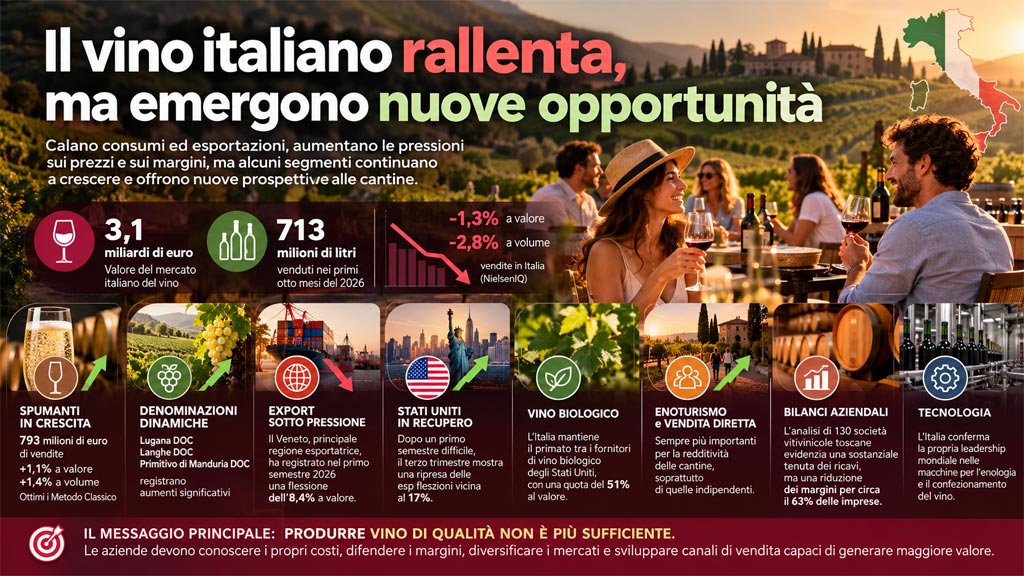
However, positive signs are emerging from sparkling wines, wine tourism, and some international markets.
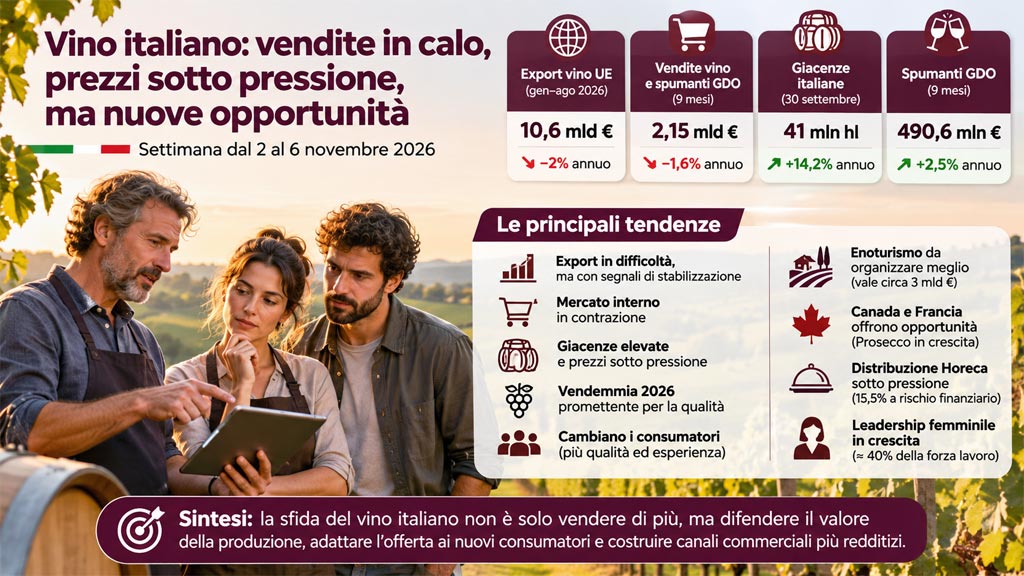
EU wine exports Jan–Aug 2026
€10.6 billion
-2% per year
Large-scale retail wine and sparkling wine sales · 9 months
€2.15 billion
-1.6% per year
Italian stocks · September 30
41 million hl
14.2% per year
GDO Sparkling Wines · 9 months
€490.6 million
2.5% per year
Processing based on data reported in the material provided: European Commission, Circana and ICQRF.
The main trends
1. Exports are struggling, but showing signs of stabilization. European wine exports totaled €10.6 billion in the first eight months of 2026, down 2%. The United States remains crucial for Italy, despite tariffs, inflation, and more cautious consumption.
2. Domestic market in decline. In the first nine months of 2026, large-scale retail trade recorded total wine and sparkling wine sales of €2.15 billion, a decrease of 1.6%. Still wines suffered the most, while sparkling wines grew.
3. High inventories and prices under pressure. Italian inventories reached 41 million hectoliters in September, an increase of 14.2%. Wholesale prices for bulk wines decreased by an average of 5.4% compared to the previous year.
4. The 2026 harvest is promising in terms of quality. Winery reports highlight generally healthy grapes and good winemaking results, despite heat, drought, and early harvests. National production is estimated at around 41 million hectoliters, 7.6% less than in 2025.
5. Consumers are changing. Among those under 35, only 14% drink wine with daily meals, while 50% associate it with special occasions. Quality, taste, and experience are becoming increasingly important.
6. Wine tourism needs to be better organized. The sector is worth approximately €3 billion in Italy, but many wineries still lack easily bookable offers, price lists for agencies, and structured collaborations with tour operators.
7. Canada and France offer opportunities. In Canada, Italy maintains a significant position among wine suppliers, while Prosecco continues to grow in France, which is listed as the appellation's third largest foreign market.
8. Horeca distribution under pressure. 15.5% of companies are at high financial risk. Protecting trade credit and ensuring the sustainability of relationships between producers and distributors are becoming priorities.
9. Growing female leadership. Women represent approximately 40% of the winemaking workforce, but are still underrepresented in management roles.
Summary: The main problem for Italian wine isn't just selling less, but being able to protect the value of production, adapt the offering to new consumers, and build more profitable sales channels.
2. Editorial version QUIDQUID News
QUIDQUID NEWS | ITALIAN WINE TREND
Italian Wine Trends – Week of November 2–6, 2026
Italian wine is changing the market: consumption is falling, stocks are high, but sparkling wines and wine tourism are growing
Strategic reading of QUIDQUID News
The Italian wine market is undergoing a transformation affecting production, consumption, exports, and corporate profitability. Sales are slowing, grape and bulk wine prices are coming under renewed pressure, and wineries are facing increasingly discerning consumers.
However, there is no shortage of concrete opportunities: sparkling wines continue to grow, wine tourism offers new revenue opportunities, and some international markets offer room for development.
The challenge for wineries is no longer simply to produce quality wines, but to defend margins, strengthen their commercial presence, and transform their production and territorial heritage into economic value.
1. Wine exports: Europe slightly recovering, United States still decisive
In the first eight months of 2026, European Union wine exports reached €10.6 billion, a 2% decrease compared to the same period in 2025.
The result represents an improvement compared to the cumulative -3% recorded in July, but confirms the difficulties facing international trade.
For Italian wine, the United States remains the main foreign market, with a strategic importance that makes the effects of tariffs, the devaluation of the dollar, and the slowdown in consumption particularly significant.
After a negative first half of the year, some summer data indicate a recovery in exports. However, it's important to distinguish between an actual recovery in demand and importers' restocking of inventories.
In this context, sparkling wines show greater resilience, while mid-range wines are more exposed to price pressure.
The priority for wineries: diversifying markets, strengthening relationships with importers, and improving their commercial positioning, avoiding competing solely on price.
2. Sales in large-scale retail trade: still wines suffer, sparkling wines grow
According to Circana data reported in its industry analyses, in the first nine months of 2026, sales of wine and sparkling wines in Italian large-scale retail trade reached 2.15 billion euros, a decrease of 1.6%.
Still wines recorded sales of 1.64 billion euros, down 2.9% in value and 4.1% in volume.
The contraction affects all the main typologies:
Sparkling wines, on the other hand, represent the positive exception, with sales of 490.6 million euros, up 2.5% in value and 3.3% in volume.
The Classic Method is particularly interesting, growing by 8.6% in value.
The share of sparkling wines in total wine and sparkling wine sales increased from 17.4% in 2020 to 22.8% in 2026.
These numbers confirm a shift in consumption occasions: less wine tied to everyday life and greater attention to convivial moments, aperitifs, and drinking experiences.
3. Inventories and prices: economic pressure on wineries remains high
One of the most sensitive elements for the sector concerns wine stocks.
As of September 30, 2026, according to Cantina Italia data from the ICQRF, Italian stocks reached approximately 41 million hectoliters, an increase of 14.2% compared to the previous year.
High product availability continues to put pressure on the prices of grapes and bulk wines.
In September, the Unioncamere-BMTI index of wholesale prices for bulk wines showed an average decrease of 5.4% on an annual basis.
Among the most significant variations in grape prices reported in the analyzed material, the following emerge:
The grapes destined for Brunello di Montalcino DOCG and Conegliano Valdobbiadene DOCG, on the other hand, are substantially stable in the references considered.
The situation highlights a structural problem: the need to maintain a balance between production, sales capacity, inventory turnover, and financial sustainability.
For many companies, the priority becomes freeing up liquidity without compromising the value of their brands and names.
4. Harvest 2026: Promising quality, but the climate requires new strategies
Initial assessments of the 2026 harvest outline a generally positive year in terms of quality, albeit with significant differences between regions.
High temperatures, low rainfall, and early ripening required timely agronomic interventions, especially in water management and harvest timing.
From Trentino to Friuli Venezia Giulia, from Veneto to Piedmont, up to Tuscany, Calabria and Sicily, numerous wineries report healthy grapes, good aromatic concentration and promising results in the first vinifications.
Yields, however, varied: some companies recorded higher-than-expected production, while others suffered reductions linked to weather conditions.
The European Commission estimates Italian production at around 41 million hectolitres, down 7.6% from 44.4 million in 2025.
This vintage confirms the importance of water availability, vineyard monitoring, agronomic adaptation, and the ability to preserve the freshness and balance of the grapes.
5. New consumers: wine loses its everyday nature, but retains its value
The relationship between Italians and wine is changing.
According to the TEHA Group survey presented in the Strategic Report Visione Vino 2026, only 14% of under-35s consume wine during daily meals, compared to 38% of over-65s.
Conversely, 50% of young people associate wine with special occasions, compared to 34% of older consumers.
Another CREA survey, conducted in 2024 on 1,038 consumers and published in 2026, found that 94.4% of the sample drank wine at least occasionally and 56.5% at least once a week.
This data does not mean that 94.4% of the entire Italian population consumes wine, but it confirms the product's widespread use in the sample examined.
When choosing a bottle, what matters most are taste, perceived quality, denomination, and price.
The range between 4 and 8 euros remains the most frequent for regular purchases, but 41.2% of those interviewed declared a maximum spending availability of more than 20 euros.
A clear direction emerges for wineries: building products and communication suited to different consumption occasions, enhancing identity, brand recognition, and the quality-price ratio.
6. Wine tourism: a 3 billion market that needs to become more organized
Italian wine tourism represents a significant opportunity to diversify wineries' revenues.
The sector is estimated to be worth around 3 billion euros, but still presents limitations in its commercial organization and collaboration with travel agencies and tour operators.
The analyses presented at Fine WineTourism Marketplace Italy 2026 show that many wineries offer quality experiences, but lack efficient booking systems, price lists reserved for intermediaries, and defined commercial conditions.
In the Winedering and Wine Meridian survey, 75% of the operators interviewed received wine tourism-related inquiries in the last year, but only 61% concluded at least one sale.
70% of operators show strong interest in packages including one or two nights on the estate, tastings, dinner and a visit to the cellar.
The German, Austrian, and Swiss markets are also particularly interesting, with 73% of respondents reporting having participated in at least one wine tourism experience in the last three years.
The outlook is clear: simply opening the cellar doors is no longer enough. Hospitality must be transformed into an organized, bookable, and commercially sustainable activity.
7. Canada and France: opportunities to be developed with targeted strategies
The Canadian market presents new opportunities for Italian wine, also following the sharp reduction in the presence of American wines in provincial distribution channels.
Between March 2025 and February 2026, Canadian wine imports from the United States decreased by 73% in volume compared to the previous twelve months.
Italy is the leading supplier in terms of volume, with approximately 77 million liters and a 21% share of the reported reference.
The growth of opportunities does not, however, eliminate the challenges: overall wine consumption in Canada is declining, and the market demands recognizable products, accessible prices, and communication that reflects local customs.
Meanwhile, in France, Prosecco continues to strengthen its presence. According to the Consortium's data reported in the news analyzed, the French market is growing by 10% and ranks third among the denomination's foreign destinations, after the United States and the United Kingdom.
For Italian companies, these developments confirm the importance of choosing markets based on the actual characteristics of the product and demand.
8. Horeca and distribution: credit protection becomes fundamental
Specialized distribution and the Horeca channel are facing an economically complex phase.
According to the CRIBIS-AGroDiPab Observatory, 15.5% of Horeca businesses present a high financial risk, compared to a national average of 10.3%.
The difficulties mainly concern liquidity, punctuality of payments and the sustainability of commercial relationships.
For wineries, this means paying greater attention to customer selection, payment terms, and concentrating revenue on a few operators.
The quality of the wine and its market presence cannot be separated from the economic solidity of the distribution network.
9. Women in wine: growing skills, innovation, and leadership
The female component is taking on an increasingly important role in the evolution of the Italian winemaking system.
According to data presented at the conference organized by the University of Milan, women represent approximately 40% of the supply chain workforce, equal to nearly 240,000 employees.
Over 28% of agricultural and winemaking businesses are led by women, while the female presence in management roles remains more limited, between 27% and 31%.
Innovation, sustainability, communication, hospitality, and collaboration between research and business are among the areas where the contribution of female professionals in the sector is growing.