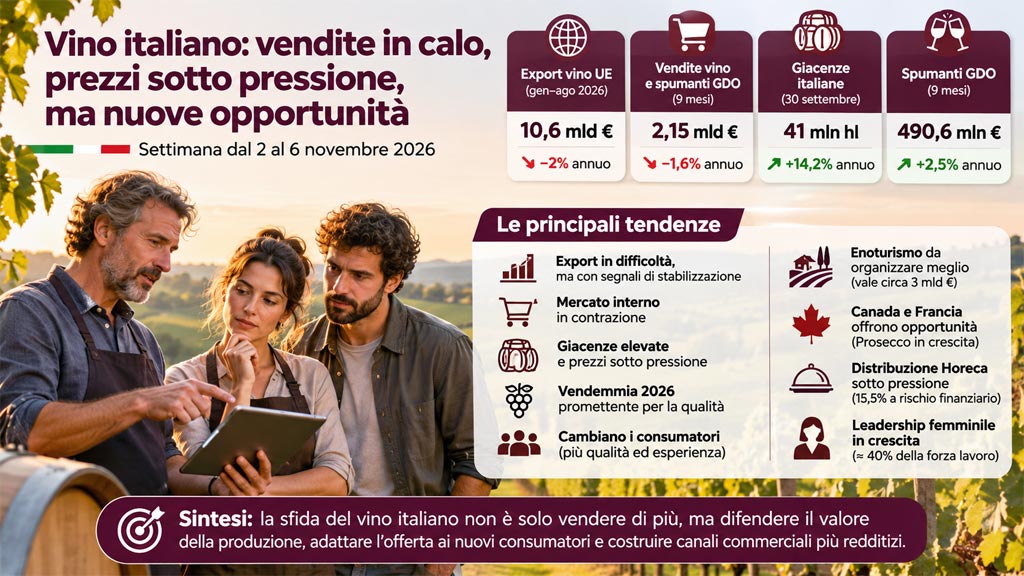
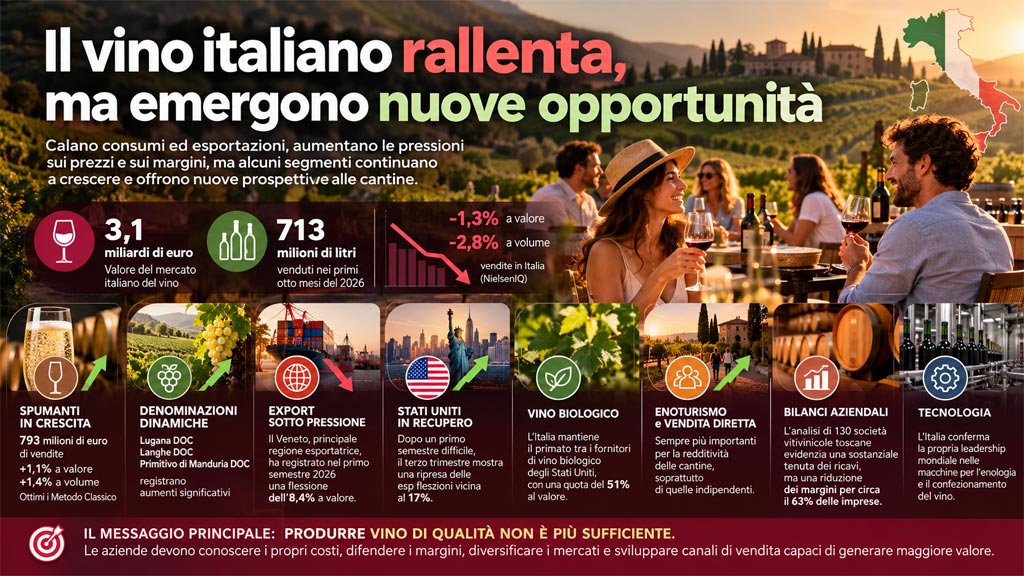
Italian wine is undergoing a transformation affecting production, distribution, consumption, and company value. The challenges lie not only in slowing sales, but also in rising costs, pressure on margins, and the need to rethink commercial strategies.
However, this week's news paints a complex picture: while the domestic market remains weak, exports are showing some signs of recovery, high-end wines maintain interesting prospects, and vineyards in the most prestigious appellations continue to represent an important asset.
The main numbers of the week
Wine stocks as of October 31st
47.7 million hl
7.2% compared to 2025
Production costs, September
8.9%
ISMEA annual variation
US exports, third quarter
17%
Value of shipments
Global Market, 2032 Forecast
$447.6 billion
Mordor Intelligence Estimate
1. Wine crisis: weaker consumption and rising production costs
The Italian Wine Union draws attention to the economic difficulties affecting wine companies.
According to data reported by UIV, October inflation stood at 5.4%, while consumer wine prices fell by 2.6%. Meanwhile, ISMEA reported an 8.9% annual increase in production costs in September.
The consequence is a progressive compression of margins: wineries incur higher costs without necessarily being able to pass them on to sales prices.
Added to this is a growing consumer focus on spending. A Noto Sondaggi survey for Il Sole 24 Ore indicates that 35% of respondents consider wine to be among the products on which they should reduce their purchases.
UIV President Lamberto Frescobaldi called for energy efficiency measures and increased resources for international promotion.
The consequence for wineries: it becomes a priority to control costs, improve inventory management, and maintain profitability, avoiding focusing exclusively on increasing production.
2. Cantina Italia: 47.7 million hectoliters of wine in stock
The ICQRF Cantina Italia bulletin highlights a further increase in inventories.
As of October 31, 2026, the following are present in Italian cellars:
61.2% of the wine is held in the northern regions, with a strong concentration in Veneto. Over 82% of the stocks are DOP and IGP wines.
Prosecco DOC represents one of the main denominations in terms of quantity of wine in storage, while maintaining a relatively favorable commercial trend compared to other categories.
The increase in inventories does not automatically mean that all the wine is unsellable, but it does signal a problem in the balance between production, marketing times, and market absorption capacity.
The consequence for wineries: inventory ties up capital and can increase financial and storage costs. Production planning and marketing strategies consistent with actual demand are required.
3. Italian wine exports: the United States returns to growth, but caution remains
After several difficult months, the third quarter of 2026 saw an improvement in Italian exports to non-EU countries.
According to the UIV Observatory, between July and September the value of extra-EU exports grew by 8%, while in the United States the quarterly increase reached 17%.
In the first nine months of 2026, extra-EU exports reached approximately 3.3 billion euros, for over 740 million liters.
Despite the recovery, the cumulative balance remains negative: -3% for non-EU countries and -6% for the United States.
The American recovery may have been supported by importers' restocking of inventories, rather than by a structural increase in consumption.
Among the markets showing positive signs are Brazil, China, and Russia, albeit with different trading conditions and risks.
The consequence for wineries: the United States remains strategic, but it is appropriate to diversify foreign markets and carefully evaluate the solidity of distributors.
4. Premium wine, sparkling wines and wine tourism: growth mainly comes from value
International prospects indicate that in the coming years the global wine market could grow more in value than in volume.
According to estimates by Mordor Intelligence, the global market will grow from 384.6 billion dollars in 2027 to 447.6 billion in 2032, with an average annual growth of 3.08%.
Volumes, however, would increase much more slowly, from 205 to 208.6 million hectolitres.
Global wine market: forecast growth 2027–2032
Overall percentage change calculated on Mordor Intelligence estimates reported in the material.
Volume Value
The difference is significant: the sector will not be able to rely solely on increased consumption to sustain revenues.
Among the segments with the best prospects are sparkling wines, with an expected annual growth of 5.05%, and rosés, with 3.9%.
Wine tourism, tastings, hospitality, and direct sales can help increase the value generated by each customer, strengthening the relationship between producer and consumer.
The consequence for wineries: the future will require greater attention to positioning, branding, distribution, and the ability to offer experiences, not just bottles.
5. Value of the vineyards: Barolo, Alto Adige, Bolgheri and Montalcino at the top
The CREA survey's forecasts for the 2025 land market confirm that vineyards in the most prestigious appellations maintain high prices, despite the sector's commercial difficulties.
The national average value of agricultural land is close to 23,000 euros per hectare, with significant differences between regions.
Here are some reference ranges for vineyards.
|
Territory |
Indicative values €/ha |
|
Barolo DOCG |
350,000–2,300,000 |
|
Caldaro Lake DOC |
600,000–1,100,000 |
|
Bolgheri DOC |
300,000–1,000,000 |
|
Brunello di Montalcino DOCG |
250,000–1,000,000 |
|
Valdobbiadene DOCG |
300,000–550,000 |
|
Asolo DOCG |
300,000–400,000 |
|
Collio DOC |
60,000–140,000 |
|
Eastern Hills of Friuli DOC |
50,000–110,000 |
|
Oltrepò Pavese DOC |
30,000–45,000 |
Source: CREA indicative values, year 2025, reported in the source material. They do not constitute certified sales prices or individual property valuations.
These data confirm that the vineyard's land holdings retain their economic significance, but the value of a vineyard does not automatically coincide with the profitability of the company that manages it.
For those intending to buy or sell a winery, it is therefore essential to distinguish the value of the land and buildings from that of the production activity, the brand, the equipment, and the ability to generate profits.
6. China: Italian organic wine presents development opportunities
The Chinese wine market continues to experience a contraction in consumption, but interesting signs are emerging for Italian organic wines.
According to a Nomisma survey for the Ita.Bio platform, promoted by ICE and FederBio, 67% of current Chinese consumers of Italian organic wine plan to increase their consumption in the next two to three years.
Furthermore, 83% of existing consumers consider Italian organic wine superior to Chinese or French organic alternatives.
The main difficulties concern pricing, distribution, recognition and communication.
The market therefore presents opportunities, especially for producers capable of enhancing the quality, origin, certifications, and identity of their products. However, it is important to consider China's specific organic certification regulations.
The consequence for wineries: organic can become a tool for commercial differentiation, but it requires a market access strategy and appropriate distribution partners.
7. Restaurants and wine shops: wine must become accessible again
From the Merano WineFestival comes a reflection on the role of catering in reviving consumer spending.
Helmuth Köcher proposed limiting bottle markups in restaurants and promoting 0.375-litre formats more.
The goal is to make wine more accessible and promote consumption opportunities compatible with new habits.
Meanwhile, Gambero Rosso's 2027 Italian Restaurant Guide lists 21 wine bars and wine shops with cuisine awarded the Tre Bottiglie, seven more than in the previous edition.
The data suggests a growing attention to the quality of service, the selection of labels and the culture of wine.
For producers, it's becoming increasingly important to collaborate with restaurateurs and wine merchants who can showcase their products as well as sell them.