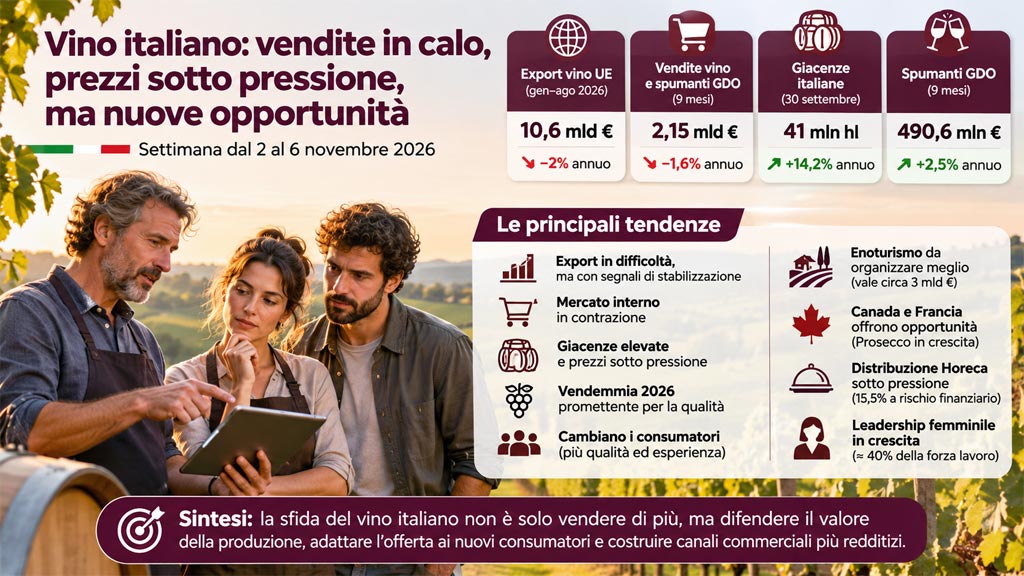
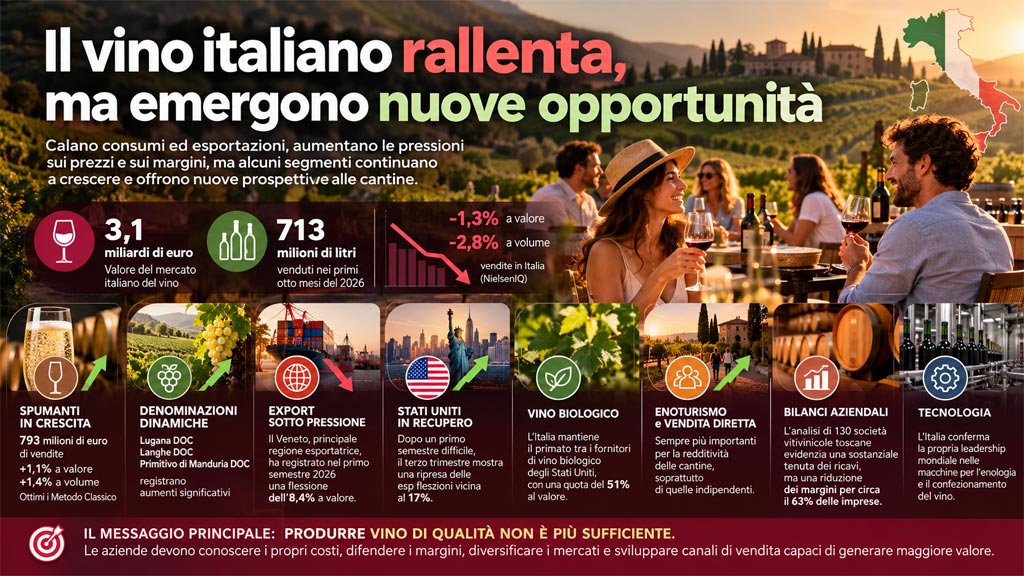
The Italian wine sector is undergoing a profound transformation. After years of growth, slowing consumption, international tensions, and rising costs are forcing companies to adopt new strategies.
However, the news from the week of November 16 to 20, 2026, shows some encouraging signs: exports are recovering some of their losses, sparkling wines are growing again, Prosecco is gaining ground in France, and several emerging markets are offering new business prospects.
The picture remains complex, but a growing consensus is emerging: the future of Italian wine will depend not only on the quantity produced and sold, but above all on the companies' ability to create value, maintain profitability, and attract new consumers.
1. Italian wine exports: recovery in the second half of the year, but the market remains difficult
Italian wine exports are showing signs of improvement after a particularly challenging first half of the year.
According to Istat data reported by sector analyses, in the first eight months of 2026, exports reached approximately 4.85 billion euros, with a still negative trend compared to 2025.
The various published surveys indicate declines between 1.7% and 3%, also as a result of the revision of historical data carried out by Istat.
The most significant data, however, concerns the recovery recorded during the summer.
In August alone, exports began to grow again, while in the first nine months the decline in sales to non-EU countries slowed from 7.5% in June to just over 2%.
The United States, the main foreign market for Italian wine, is also showing an improvement, although it remains affected by uncertainty over tariffs, currency exchange rates, and declining consumption.
Reading QUIDQUID News
The recovery is a positive sign, but it does not yet represent a consolidated recovery.
Italian wineries must continue to dominate traditional markets, while simultaneously strengthening their presence in new geographical areas.
Trade diversification is becoming increasingly important to reduce dependence on a few large importers and protect business stability.
2. Prosecco takes centre stage in France: it has overtaken Champagne in large-scale distribution.
One of the most significant news of the week comes from France, the home of Champagne.
According to Circana surveys, in the twelve months ending in August 2026, Prosecco surpassed Champagne in volumes sold in French large-scale food retailing.
The data indicates:
The result confirms a shift in preferences among a segment of French consumers, who are increasingly attentive to the balance between quality, price, and consumption opportunities.
Prosecco's success is also part of a growing interest in Italian food and wine, which also includes aperitifs, liqueurs, and food products.
It is important to point out that the overtaking concerns large-scale distribution and not the entire French sparkling wine market.
Reading QUIDQUID News
Prosecco demonstrates the importance of offering a recognizable, accessible product that can easily be associated with a consumer experience.
For Italian companies, the result opens up further opportunities, but also highlights a need: to defend the value of denominations, preventing competition from focusing exclusively on price.
Volume growth must translate into sustainable profitability for producers, bottlers, and the winemaking industry.
3. New markets: Eastern Europe, Asia and Latin America offer opportunities
The search for new commercial outlets is one of the main priorities of the sector.
According to Nomisma Wine Monitor, in the first half of 2026, Italian wine imports to 13 emerging markets increased by 5.9% in value, while overall wine imports to the same countries decreased by 3.7%.
Among the most interesting markets are Romania, Czech Republic, Poland, Turkey, Vietnam, Thailand, South Korea, Mexico and Brazil.
Some long-term results are particularly significant.
Between 2015 and 2025, Italian exports grew by 507% to Romania, 325% to Türkiye, and 264% to Vietnam.
Brazil also continues to show positive signs, with Italian wine imports growing by 6% in the first nine months of 2026.
Reading QUIDQUID News
These markets cannot yet replace the United States, Germany and the United Kingdom, but they represent an important development opportunity.
For Italian wineries, it is essential to develop differentiated commercial strategies, identify reliable distributors, and adapt products, communications, and positioning to the specific characteristics of individual countries.
Internationalization must not only be about finding new customers, but also about building lasting business relationships.
4. Wine consumption: difficulties for red wines, longer-lasting sparkling wines
The slowdown in consumption does not only concern Italy, but also affects many of the main international markets.
According to analyses presented by Nomisma Wine Monitor, global wine consumption has increased from 232 million hectoliters in 2020 to approximately 208 million in 2025.
The Italian market also confirms this trend.
In the first nine months of 2026, in large-scale distribution:
This data highlights a change in purchasing habits and consumption occasions.
Wine is increasingly chosen based on experience, conviviality, price, and product recognition.
Reading QUIDQUID News
Companies must ask themselves not only how much wine to produce, but what wines the market will be willing to purchase in the coming years.
It is becoming important to review product ranges, commercial policies, formats, and distribution channels.
The ability to adapt offerings to new consumer behaviors will be crucial to maintaining competitiveness.
5. Brunello di Montalcino: the value of the denomination supports the market
Even high-end wines are feeling the effects of international difficulties, but the most recognized denominations are demonstrating a greater ability to defend their positioning.
According to estimates from the UIV Observatory for the Brunello di Montalcino Consortium, 2026 should close with:
The United States remains a key market, despite recording an 8% contraction in the value of consumer sales.
Canada bucked the trend, growing by 15%.
The denomination continues to invest in international promotion, enhancing the territory, reputation, and identity of the product.
Reading QUIDQUID News
The Brunello case confirms that a strong territorial brand is an important protection in times of difficulty.
However, even prestigious denominations must invest in distribution and communication.
The value of a winery increasingly depends on the combination of its viticultural heritage, production quality, commercial reputation, and ability to generate margins.
6. Italian wineries and digital: being online doesn't mean selling
Digital transformation represents another major challenge.
Quodigi's Wine Observatory, conducted on 33 Italian wineries, highlights a widespread digital presence, but also significant differences in their ability to transform online visibility into commercial results.
The average digital competitiveness index of the sample stands at 56.3 points out of 100.
Among the best-positioned companies are Donnafugata, Banfi, Ca' del Bosco, Cusumano and Antinori.
The main criticality concerns the measurement of results.
Many wineries invest in websites, social networks, and advertising, but still lack sufficient tools to understand which activities generate sales, qualified leads, or wine tourism bookings.
Reading QUIDQUID News
Digital communication must become a measurable commercial tool.
It's not enough to tell the story of the area or publish images of the bottles.
We need to build paths that guide customers from brand awareness to purchase, from a visit to the winery to loyalty.
Artificial intelligence can also help improve companies' visibility, as long as the content is clear, up-to-date, reliable, and genuinely useful.
7. Wine tourism, sustainability, and new skills: value beyond the bottle
The future of Italian wine also depends on the ability to promote activities complementary to production.
According to data presented at WIN& – Mostra della Cultura del Vino Italiano (Italian Wine Culture Exhibition), wine tourism generated over 3 billion euros in 2025, representing an average of 21% of the turnover of the companies analyzed.
Hospitality, tastings, and direct sales enable wineries to strengthen relationships with consumers and diversify their revenue.
At the same time, the importance of environmental, economic and social sustainability is growing.
Certifications, water resource management, energy consumption reduction, and people empowerment are becoming increasingly important factors in competing on the market.
Reading QUIDQUID News
Wineries must be considered complex economic systems, in which production, real estate, branding, tourism, and distribution contribute to the creation of value.
Investing in sustainability also means improving production efficiency and reducing costs in the medium term.
Wine tourism, when supported by an economically viable project, can represent an important source of additional profitability.
8. The future of wine: communicating better and reaching new consumers
During the WIN& meetings in Rome, companies and experts addressed the topic of generational change and the need to make wine more understandable.
The complexity of denominations, grape varieties, and the language used by operators can represent a barrier for those new to the sector.
Wine must continue to express culture, territory, and tradition, but through simpler and more accessible communication.
The relationship between alcohol and health also remains central, requiring scientifically accurate, transparent information and the promotion of responsible consumption, without downplaying the health risks associated with alcohol.
Reading WINE IDEA News
The sector must learn to speak not only to experts, but also to those who want to learn about wine without undergoing a technical journey.
The consumer of the future will seek authenticity, quality, experiences and understandable information.
Wineries capable of interpreting these needs will be able to build stronger and more lasting relationships.
WINE TRENDS IN ITALY – WEEK OF NOVEMBER 16-20, 2026
WINEIDEA News' strategic vision: 2027 will be the year of choices
This week's news highlights a sector that is progressively changing its balance.
The recovery in exports, the success of Prosecco in France, and the growth of some emerging markets are encouraging signs.
However, the structural slowdown in consumption and the growing pressure on margins require concrete business decisions.
Five strategic priorities emerge for wine companies:
1. Defend profitability. Don't just chase volumes, but improve margins, production efficiency, and distribution quality.
2. Diversify markets. Consolidate traditional destinations and gradually develop new international opportunities.
3. Strengthen corporate value. Invest in brands, reputation, vineyards, production facilities, and marketing capabilities.
4. Integrate new revenue streams. Enhance direct sales, wine tourism, hospitality, and consumer relations.
5. Evaluate new industrial operations. Consider collaborations, mergers, acquisitions, investor participation, and generational transitions as potential tools to strengthen businesses.
Conclusion: less quantity, more value
Italian wine still boasts an extraordinary heritage: world-renowned territories, prestigious denominations, production expertise, and an entrepreneurial tradition that is difficult to replicate.
But prestige alone does not guarantee financial results.
The challenge for the coming years will be to transform this heritage into more solid, competitive companies capable of tackling ever-evolving markets.
The future of Italian wine will not be determined solely by how many bottles we sell, but by the economic, cultural, and commercial value we build around each bottle.
This is the perspective from which WINE IDEA News will continue to observe the market: not just reporting the news, but interpreting its consequences for producers, entrepreneurs, and investors.
WINEIDEA News – Information, analysis, and strategic vision for the Italian wine sector.