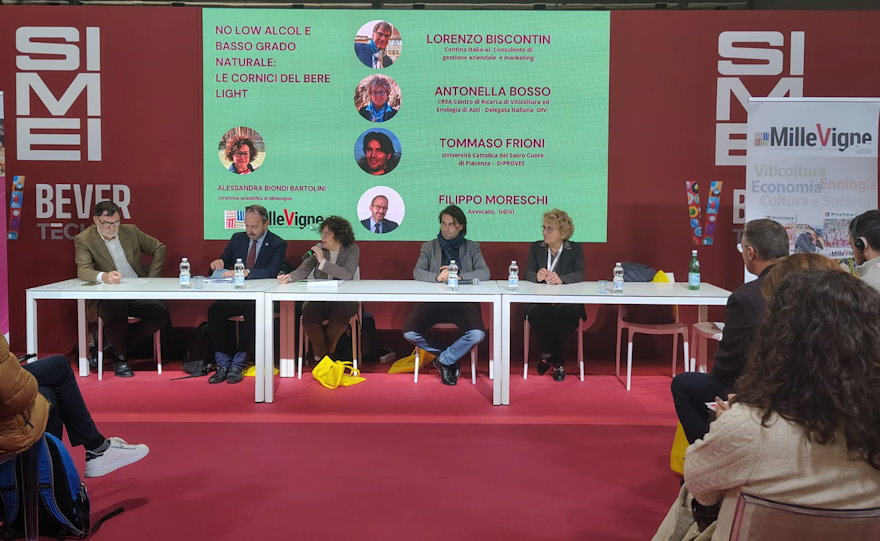
What are the regulatory, agronomic, technological, and market boundaries of low- or zero-alcohol wines? This question was answered by the workshop "No low alcohol and low natural alcohol: the frameworks for light drinking," organized by Millevigne and held on Tuesday, November 17, in the Conference Room of Pavilion 4 of SIMEI (Fiera Milano Rho).
Moderated by Millevigne's scientific director, Alessandra Biondi Bartolini , the event outlined a true taxonomy of light drinking , focusing on two distinct paths: dealcohol removal in the cellar and the production of grapes from the vineyard intended for wines with a low natural alcohol content.
" We're talking about no- and low-alcohol wines: on the one hand, dealcoholized and partially dealcoholized wines, and on the other, wines that originate with a low alcohol content and are defined as naturally low-alcohol. They are all the result of a process—uncommon in the wine sector—of product innovation, and therefore require careful study, preparation, and planning: knowledge of the markets, consumer expectations, regulatory framework, adaptation of viticultural techniques, and selection of the best winemaking technologies and practices. Because the goal must not only be to enter this new market segment, but to do so with quality, delicious, and interesting products," explained Biondi Bartolini in his introduction.
Consumer trends and the "Taste-First" philosophy
The session was opened by Lorenzo Biscontin , CEO of Cantina Italia.ai and a business management and marketing consultant, who analyzed the performance of the main international markets based on IWSR data. A total of 688,000 hectoliters of alcohol-free and low-alcohol wine are sold worldwide, with alcohol-free wine dominating. In 2023, the United States alone accounted for 38% of total consumption, while the United Kingdom and Germany lead European consumption, and countries like Canada and Japan are showing the most dynamic annual growth rates, approaching 30% for the alcohol-free segment. However, three main barriers to purchase remain: the preference for full-strength products, strong competition from other beverages, and a negative perception of taste. To overcome these obstacles, Biscontin cited the international case of Stella Rosa and CEO Steve Riboli's "Taste-First" philosophy, based on four pillars: transparency towards consumers, innovation in flavors while respecting tradition, positioning as a true alternative to wine, and maximum consistency in quality.
The legal framework: labelling rules and limits for Geographical Indications
Filippo Moreschi , lawyer of the Mantua Bar and Vice President of the Union of Vine and Wine Jurists (UGIVI), clarified the European and national legislative framework, from EU Regulation 2117/2021 to the Italian Ministerial Decrees of 2024 and 2025 and the recent Regulation 471/2026, the so-called “Wine Package”. Moreschi recalled that in Italy there is a ban on dealcoholization for wines with Geographical Indication (DOP and IGP) and illustrated the new labelling: from 19 September 2027, the current terms "dealcoholized" and "partially dealcoholized" will be replaced by the terms "Zero alcohol" (or "0.0%" if the alcoholic strength does not exceed 0.05% vol.) and "Reduced alcohol content" (above 0.5% vol.), accompanied by the indication "obtained through dealcoholization" .
The path for low natural alcohol content is different: by using agronomic and oenological techniques without dealcoholization, one remains fully within the "wine" category, as defined by EU Regulation 1308/2013, an option also viable for GIs, subject to modification of the respective production specifications.
The agronomic way: towards a new model
On the viticultural front, Tommaso Frioni of DIPROVES - Università Cattolica del Sacro Cuore in Piacenza, explained the physiological foundations that will be needed to develop new viticultural strategies. The goal is to limit sugar accumulation in the grapes without compromising the aromatic and acid balance. Among the solutions successfully tested are drastic pre-veraison pruning and the use of natural antiperspirants around the bunches. Finally, Frioni outlined guidelines for a future "vineyard model" dedicated to low-alcohol wines, based on new practices to be adopted with a specific and different objective in mind, while also focusing on economic as well as environmental sustainability.
Cellar technologies and the cross-border DEVIN0 project
Antonella Bosso of CREA - Asti Research Center for Viticulture and Oenology and the Italian OIV delegate completed the technical discussion. She illustrated the advantages and limitations of currently authorized dealcoholization technologies, from evaporation and vacuum distillation to membrane techniques such as reverse osmosis and osmotic distillation. Bosso presented the initial developments of the Interreg VI-A Italy-France ALCOTRA 2021-2027 DEVIN0 cross-border project, which is testing these technologies on Italian (Barbera, Dolcetto, Cortese, Moscato Bianco, Brachetto) and French (Grenache, Syrah, Vermentino, Cinsault) varieties.
The discussion at SIMEI confirmed that "light drinking" requires a rigorous and informed approach from the winemaking industry: understanding regulatory constraints and choosing the most suitable technical tools in the field and cellar is now key to entering new and untapped segments and markets.
10/11/2026

11/10/2026

21/04/2026

17/04/2026