But what happens when that information meets direct experience, memory, and personal interpretations? NP Wine Experience addresses this question through Algorithm, an interactive tasting format that uses wine to bring to life a topic that's now central to the business world: the relationship between data and the human ability to attribute meaning to it.
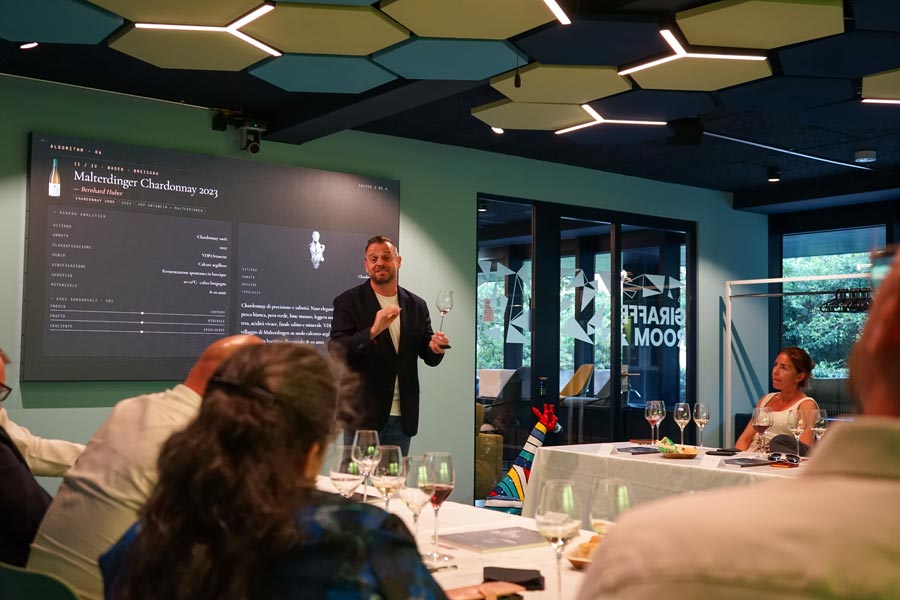
The journey unfolds through four wines in a specific order: first, participants taste and describe their impressions; only then do they discover the interpretation produced by the artificial intelligence based on each wine's technical sheet. The comparison reveals similarities, differences, and, above all, the weight of the initial information. The AI, in fact, doesn't taste the wine: it processes available data and descriptions, while those present also bring their own perceptions, associations, and individual experiences to the glass.
Participants' impressions are collected via a web application accessible via QR code. An interactive presentation accompanies the various phases, while Francesco Pagani, wine advisor and co-founder of NP Wine Experience, guides the narrative of the wines and the dialogue between the different points of view. It's not about deciding who wins between humans and machines, but rather observing how the responses change when the sources, questions, and context change.
The selection includes four European wines, presented in two pairs: a Chardonnay from Chassagne-Montrachet and one from Malterdingen, Baden; a Pinot Noir from Volnay and a Spätburgunder from Kaiserstuhl. The comparison between different terroirs highlights how the same grape variety can take on different expressions depending on the location, the vintage, and the producers' choices. It is precisely the history of these decisions that lends depth to the technical information.
Algorithm is designed for groups of 8 to 30 participants. The experience lasts approximately 75 minutes and can be extended to two hours with dinner. It is adaptable to corporate offices, private residences, hotels, and restaurants, and is particularly suited to management groups and businesses looking to engage in discussions on artificial intelligence without resorting to a classroom lecture.
The topic extends beyond the wine industry. Even within organizations, having information doesn't automatically equate to understanding all its implications. Algorithm invites us to question the role of judgment, experience, and the questions we ask of data: elements that can complement technological tools when addressing complex situations and making decisions.
"My work begins where tasting usually ends," Francesco Pagani summarizes. His work stems from the independent selection of producers, a presence in the local areas, and a direct relationship with those who make the wine. Through Algorithm, this approach becomes a shared experience in which wine doesn't offer a definitive answer, but rather opens new perspectives on how we observe and interpret reality.

11/10/2026

21/04/2026

17/04/2026

14/03/2026