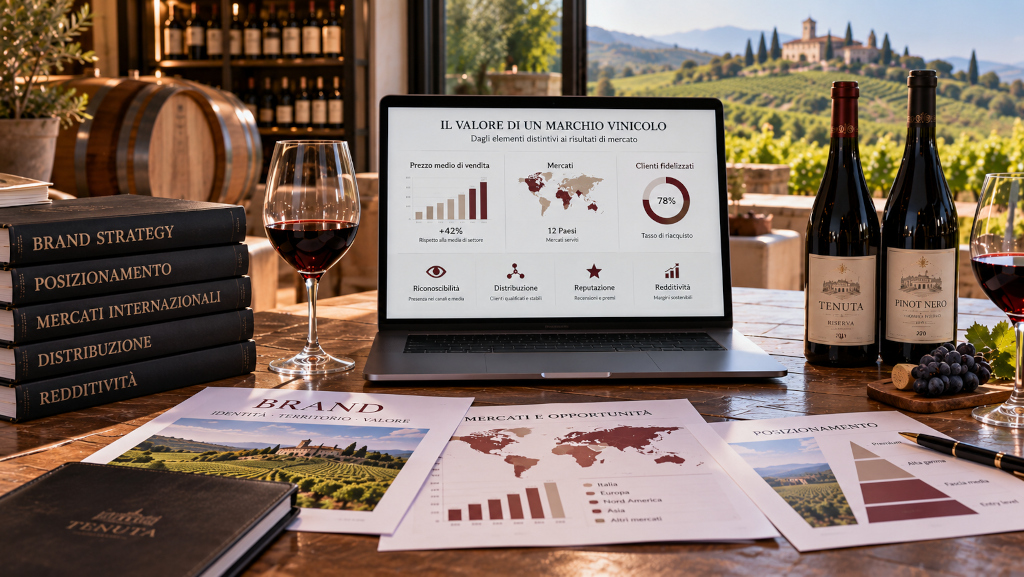
The difference between a winery that struggles to sell and one that manages to defend its prices and margins often depends on the ability to transform its identity into a recognizable, credible, and commercially competitive brand.
Many Italian wineries boast quality vineyards, modern cellars, winemaking expertise, and a rich history. Yet, these elements don't always translate into adequate market value.
The problem isn't necessarily the wine. Often, it's its positioning.
A brand may be well-known in its local area, appreciated by industry professionals, and awarded in competitions, but fail to command profitable prices or maintain a stable presence on the markets.
For this reason, the value of a wine brand must be analyzed through concrete results , not just through reputation or advertising investments.
1. The average selling price: the first indicator
Price is one of the most immediate indicators of a brand's ability to create value.
Two wineries can produce wines of the same denomination, with comparable qualitative characteristics, but sell them at significantly different prices.
The difference may depend on several factors:
However, a high price does not automatically mean higher profitability .
It is necessary to verify the average price actually collected, net of discounts, promotions and commercial conditions, comparing it with production and distribution costs.
A brand creates value when it allows for profitable prices to be sustained without compromising the continuity of sales.
2. Recognizability: being known does not mean being chosen
Brand awareness represents a commercial asset only when it concretely influences purchasing decisions.
A winery can invest in trade fairs, tastings, digital communications, and wine awards without achieving commensurate results.
The question to ask is simple:
How many customers buy our wine because they recognize and prefer our brand?
To answer this question, we need to analyze some elements:
The commercial value of notoriety is manifested above all in the ability to generate demand and sustain repeat sales.
3. Distribution: the brand is also valid for the markets it manages to reach
A good distribution network can represent one of the most important elements of a winery's commercial assets.
It's not just the number of markets served that counts, but above all the quality of commercial relationships.
A brand present in ten countries, but with occasional sales, may have a less solid commercial structure than a company concentrated in three markets with reliable distributors and recurring orders.
Indicators to consider include:
Distribution contributes to brand value when it is stable, diversified and consistent with the positioning of the wines.
4. Customer loyalty: the value that builds over time
Acquiring a new customer requires business investment. Retaining them over time allows you to build a more predictable revenue base.
For a winery, loyalty concerns distributors, importers, restaurateurs, wine shops and end consumers.
It is useful to measure:
A stable customer base can help reduce business uncertainty and improve production planning.
For an investor interested in acquiring a winery, this information can be as important as the vineyard area or the plant capacity.
5. Product portfolio: less confusion, more identity
Over time, many wineries have developed a large number of labels, commercial lines, and price ranges.
This choice may meet distribution needs, but it risks weakening the brand's identity.
An effective product portfolio should have a comprehensible structure:
Each reference should have a specific function.
It's not the number of labels that determines the strength of a winery, but the ability of each product to contribute to turnover, margins, and overall positioning.
6. How to concretely measure the commercial value of the brand
FORBUS proposes to start from the integrated analysis of five dimensions.
|
Indicator |
What to measure |
|
Average price |
Net price per bottle, per line and per channel |
|
Recognizability |
Spontaneous questions, brand searches and commercial inquiries |
|
Distribution |
Active markets, customers, continuity and margins |
|
Fidelity |
Reorder rate and relationship duration |
|
Product portfolio |
Profitability, rotation and consistency of references |
These indicators do not automatically produce an economic evaluation of the brand, but they allow us to identify its strengths and weaknesses.
To assign an independent monetary value to the brand, a specific analysis of the economic benefits attributable to it is required, avoiding confusion with those generated by vineyards, plants, organization, and sales network.
7. A practical example: how much can positioning affect?
Let's consider a winery with a marketed production of 300,000 bottles per year.
Initial situation
Positioning improvement scenario
Result: €150,000 of additional annual turnover , equal to a 10% growth, with constant volumes.
This example is for illustrative purposes only and does not relate to a real company.
Of course, increased turnover does not necessarily equate to an equal increase in profits: commercial investments, marketing, any increased costs, and the sustainability of the new prices must be considered.
The example, however, demonstrates how significant it can be to work on the value recognized by the market, rather than simply trying to increase volumes.
8. The brand in the evaluation and sale of a winery
When a winery is pitched to an investor, attention often focuses on the vineyards, real estate, facilities, warehouse, and revenue.
But there is another component to analyze: the brand's ability to generate future revenue and maintain commercial relationships even after a possible change of ownership.
An established brand, supported by effective distribution and loyal customers, can contribute to the company's attractiveness and the overall value of the operation.
Conversely, a winery with little brand recognition, concentrated sales to a few customers, and insufficient margins may require significant post-acquisition investments.
For this reason, commercial valorization should begin, if possible, before a sales process.
9. The FORBUS method: from brand to economic result
FORBUS supports wineries in analyzing and developing their commercial positioning, with an approach that connects strategy, organization, distribution, and financial results.
The path can include five interventions:
1. Analyze current positioning. Understand how the market perceives wines, their prices, and actual competitors.
2. Profitability Review. Identify which products, customers, and markets contribute most to company margins.
3. Portfolio rationalization. Strengthen strategic references and evaluate those that are absorbing resources without generating adequate results.
4. Business development. Improve distribution quality, identify new partners, and consolidate existing relationships.
5. Measure results. Define periodic indicators to verify actual improvements in prices, margins, sales, and business continuity.
The goal is not simply to make the brand more visible, but to transform it into a tool capable of supporting the development of the company.
Conclusion: A strong brand must produce results
The value of a winery does not depend solely on the hectares of vineyards, production capacity, or the quality of the bottles.
It also depends on the ability to gain market trust, retain customers, defend profitable prices and build sustainable business prospects.
A strong brand isn't necessarily one that communicates the most. It's one that manages to transform its identity into demonstrable economic value.
For many Italian wineries, there's still room for improvement. Identifying it and turning it into results can be a crucial step towards business growth and a potential future acquisition.
FORBUS | We evaluate your brand positioning
Does your winery produce quality wines, but prices, margins, or distribution don't fully reflect its potential?
FORBUS can assist you in analyzing your positioning, promoting your business, and defining a concrete development plan.
Not just communication, but a strategy linked to the company's financial results.
Let's evaluate your brand positioning together.
12/11/2026

11/11/2026

11/11/2026

09/11/2026