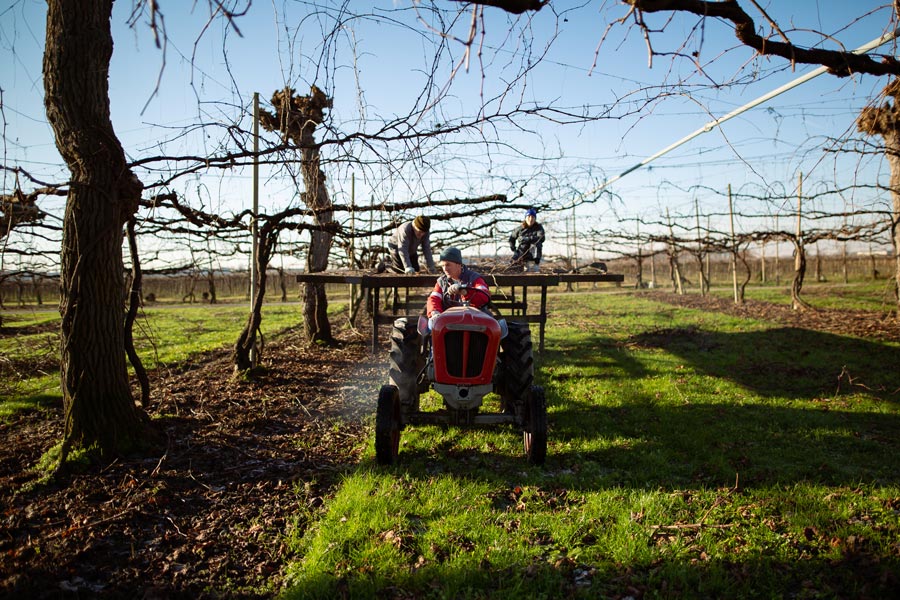
The training sessions will begin on November 25th and aim to provide winemaking companies with refresher courses and concrete tools to address the sector's environmental and production challenges. The courses are aimed at farmers (owners, members, and employees of Veneto-based farms) interested in learning more about methods and solutions for more efficient, sustainable, and ecosystem-friendly vineyard management. The schedule of upcoming courses and registration details are available on the Consorzio Vini Venezia website : https://www.consorziovinivenezia.it/corsi-di-formazione-innobiovit/ . Registration is open until November 19th.
The INNOBIOVIT project adopts an interactive and participatory innovation model, based on collaboration between farms, research institutions, technical consultants, and other stakeholders in the grape-wine supply chain. It is developed across four areas of intervention: coordination, vineyard, winery, and dissemination. This integrated approach allows for the integration of field trials, environmental performance measurement, and knowledge transfer to businesses. INNOBIOVIT thus continues its commitment to promoting a culture of sustainability based on collaboration, innovation, and the dissemination of concrete expertise, for the benefit of wineries, the environment, and consumers.
The project's Operational Group brings together partners with complementary skills, who collaborate in the various phases of design, testing, validation, and dissemination of results.
CREA - Council for Agricultural Research and Analysis of Agricultural Economics , the project's lead partner, provides technical and scientific support for sustainable vineyard management strategies and integrated pest management. DESAM Ingegneria e Ambiente contributes to the measurement of environmental indicators and the development of the vineyard performance indicator, while the TESAF Department of the University of Padua offers its expertise in agricultural soil management and conservation. VIVO Cantine facilitates the transfer of results to member companies, contributing to the dissemination of innovative practices and the collection of data necessary to assess impacts in the winery. Studio Vassallo is responsible for administrative coordination and liaison with the European networks PEI-AGRI and AKIS, supporting governance and dissemination activities. The Consorzio Vini Venezia and Studio Vassallo are involved in dissemination activities, which are essential for promoting the dissemination of results and the extension of the model at the regional and national levels. Finally , Gianesin Canepari & Partners , accredited by the Veneto Region, is responsible for the planned activities through courses aimed at producers, technicians and operators in the supply chain.

11/11/2026

11/11/2026
09/11/2026

07/11/2026