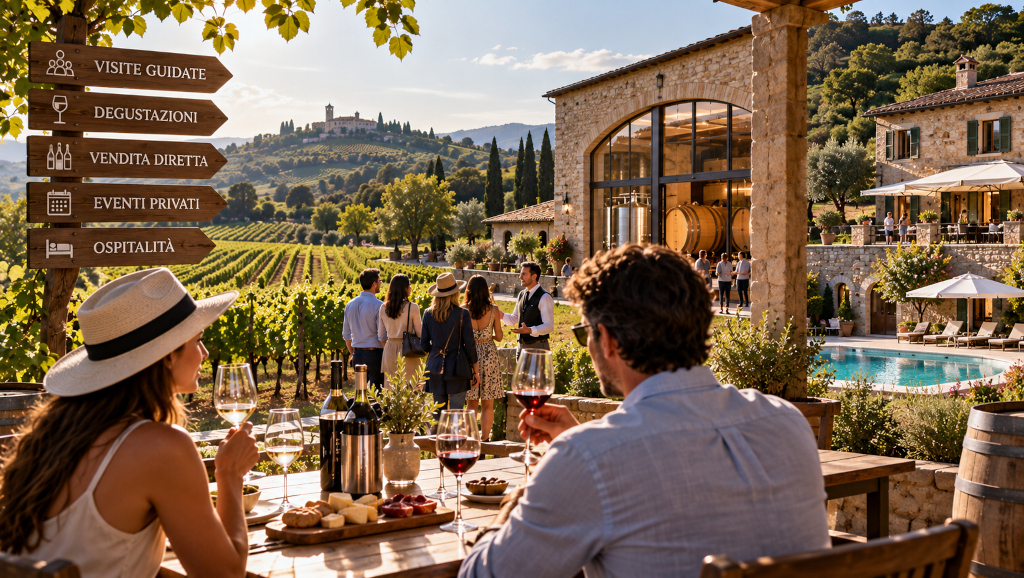
However, there is a fundamental difference between a winery that organizes tastings and a company that has built a wine tourism business capable of generating revenue, strengthening its brand, and increasing the value of the company.
The question every owner should ask himself is not how many visitors he can attract, but how much economic value he can create through those visitors.
Because a well-developed wine tourism project can improve not only revenue but also the winery's attractiveness to potential investors and buyers.
1. Wine tourism is not just hospitality: it is an economic activity
Many wineries already possess the necessary conditions to develop a wine tourism offering: vineyards in recognized territories, rural properties, tasting rooms, family history, and quality products.
But owning these resources does not automatically mean being able to turn them into a profitable business.
A project may include:
Every business must have its own balance between revenues, costs, personnel and investments.
Success is not only measured by the number of visitors, but by the financial margin that each experience leaves the company.
2. Direct selling can improve profitability
One of the main advantages of wine tourism is the possibility of building a direct commercial relationship with the consumer.
A visitor who knows the producer, understands the region, and tastes the wines can become a regular customer, purchase online, and recommend the company to other consumers.
Direct sales, when properly organized, also allow you to retain a greater share of the commercial value compared to channels that involve multiple intermediaries.
But you also need to consider the costs of reception, point of sale management, communication, shipping and loyalty.
The goal is to build a business relationship that continues even after the visit to the winery.
3. How much can a wine tourism project earn?
To understand the economic potential, let's consider a purely illustrative simulation of a medium-sized winery.
Wine tourism economic simulator
Adjust assumptions to estimate annual revenue and contribution margin, before additional fixed costs.
Annual visitors
3000
Average experience price
€30
Average expenditure of wine buyers
€35
Visitors who purchase
50%
Estimated variable costs on revenues
40%
Income from experiences
€90,000
Direct sales
€52,500
Total revenues
€142,500
Contribution margin
€85,500
Non-forecast simulation, with hypothetical values and net of VAT. The margin does not represent profit: fixed costs, depreciation, taxes, investments, and other charges must still be considered. Direct sales revenue is considered additional only if it does not replace existing sales.
This example demonstrates how wine tourism can create a new source of revenue, but also why a professional assessment must consider the actual financial result.
A winery with many visitors, but high costs and poor sales, may be less profitable than a smaller, carefully organized facility.
4. Hospitality and real estate: when is the investment justified?
The availability of farmhouses, rural buildings, or unused structures can make the development of rooms, apartments, farmhouses, or small wine resorts attractive.
The investment, however, must be evaluated considering several factors:
A renovated property does not necessarily increase the economic value of the business by an amount equal to the invested capital.
Added value arises when real estate investment produces sustainable income or concretely strengthens the commercial attractiveness of the property.
5. How much does wine tourism impact a winery's sales value?
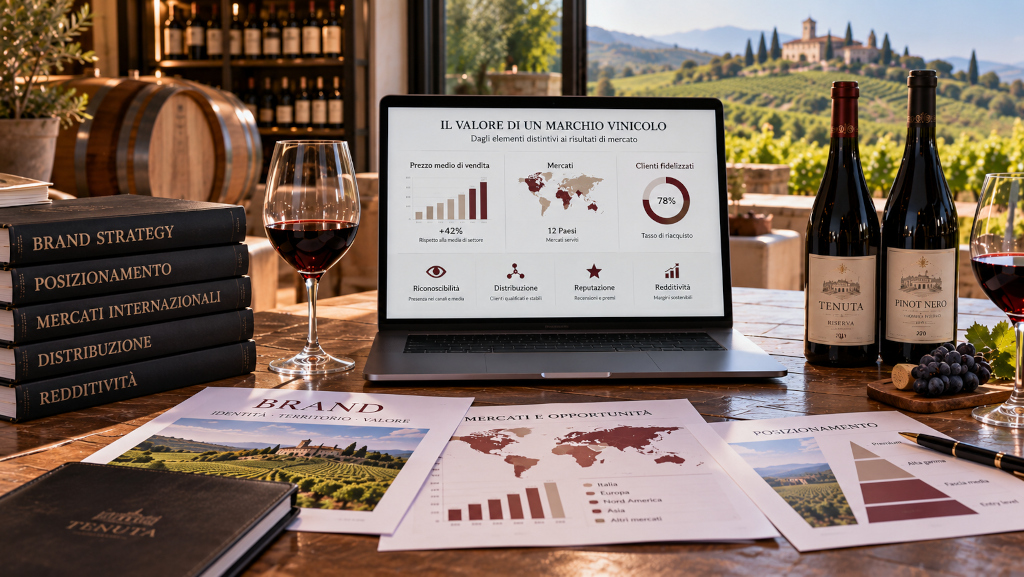
For a potential buyer, an organized wine tourism business can be a positive asset, especially when it has documented financial results and a transferable management structure.
A winery that generates diversified revenues, has a loyal customer base, and operates direct sales channels may have attractive characteristics compared to a business that relies exclusively on traditional distribution.
But in the evaluation it is necessary to distinguish three components.
|
Component |
How can it create value? |
|
Real estate assets |
Renovated buildings, accommodation facilities and functional spaces |
|
Operating profitability |
Recurring margins from visits, tastings, hospitality and direct sales |
|
Commercial value |
Loyal customers, brand awareness and business relationships |
These elements must be analyzed avoiding counting the same economic benefit twice.
A qualified buyer will want to know not only how much wine tourism revenues, but also how much it costs to run, what investments are required, and how much it depends on the owner's personal presence.
6. The most common mistake: investing before knowing the market
A winery may decide to renovate a farmhouse, build a tasting room, or hire dedicated staff without having assessed potential demand.
It's a real risk.
Before investing, you need to answer some questions:
Who will be visiting the winery? Italian tourists, foreigners, wine enthusiasts, organized groups, or corporate clients?
How much will you be willing to spend? A €20 experience and a €100 private tasting require different organization and positioning.
How will customers arrive? Through your company website, hotels, tour operators, booking platforms, or local partnerships?
Who will manage the service? The winery staff may not have the necessary skills for reception, reservations, sales, and hospitality.
When will the investment break even? It's necessary to estimate volumes, costs, margins, cash flows, and payback periods.
Without these answers, the project risks becoming a permanent cost rather than a development opportunity.
7. The FORBUS method: from the idea to the economically sustainable project
FORBUS approaches wine tourism development by starting from the analysis of the business, not from the simple design of the spaces.
The goal is to identify the model best suited to the size of the winery, the territory, the available resources, and the owners' expectations.
The process includes five fundamental steps.
Potential analysis
Evaluation of properties, vineyards, geographic location, tourist flows, brand, and organizational capacity.
Economic and financial plan
Estimate investments, expected revenues, operating costs, margins, and payback times.
Organization and partnership
Identifying the necessary skills and potential partners for hosting, marketing, and promotion.
Business Development
Definition of experiences, pricing, booking channels, and direct sales strategies.
Measuring Results
Monitor attendance, revenue per visitor, margins, facility occupancy, and return on investment.
The approach can be applied both to wineries looking to develop a new business and to properties looking to increase their value before a potential sale.
8. Before selling a winery, is it worth developing its wine tourism potential?
In some cases, yes. But not always.
A property with unused buildings, vineyards in an attractive location, and a recognizable brand could have untapped commercial potential.
Launching a wine tourism project before selling can help improve the company's positioning and, over time, its profitability.
In other cases, however, it may be preferable to present the investor with a pre-designed development project, with preliminary checks and a credible business plan, without committing the owner to investments they don't want to make.
The choice depends on the entrepreneur's objectives, available resources, and the expected timeframe for the potential operation.
Conclusion: the real value is not in the number of visitors
Wine tourism can become an important tool for diversifying revenue, strengthening the brand, and enhancing a winery's assets.
But it's not a one-size-fits-all solution.
Its contribution to corporate value depends on the ability to generate financial results, maintain quality service, and develop lasting business relationships.
A winery isn't worth more simply because it welcomes tourists. It's worth more when it manages to translate that hospitality into profitability, recognition, and concrete growth prospects.
This is the difference between a sideline and a true business development project.
FORBUS | CORPORATE DEVELOPMENT AND ENHANCEMENT
We evaluate the wine tourism potential of your winery
Do you own a winery, a wine estate, or rural properties that could be enhanced through wine tourism?
FORBUS can assist you in analyzing opportunities, defining the project, and assessing its economic sustainability, coordinating the necessary skills for development.
Before investing, let's find out together if and how much value your property can generate.
Discover FORBUS and request a quote at www.forbus.it

14/11/2026
13/11/2026
12/11/2026

11/11/2026