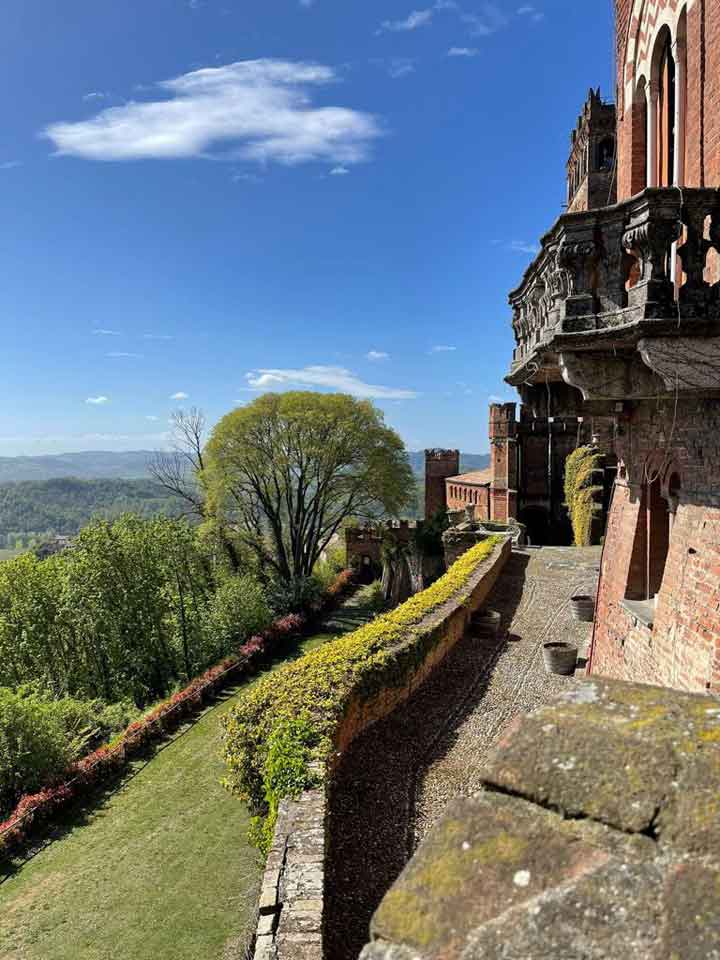
A full day dedicated to Baratuciat, an ancient and rare vine once cultivated in the Susa Valley, now rediscovered and re-evaluated, which is becoming more and more known and appreciated for its extraordinary viticultural and oenological aptitudes. It will take place on Sunday 23 July at the Castle of Camino (Alessandria) . The title chosen by the organizers is « Baratuciat , vine in the cam(m)ino between Valsusa, Langhe and Monferrato ».
Plan
The day will open at 10.30 with a brief presentation of the Baratuciat, its history and characteristics. This will be followed by a Master class dedicated to this wine in its various types (sparkling, still white, passito) and nuances, linked above all to the different cultivation areas (Valsusa, Monferrato, Langhe). The oenologist Gianpiero Gerbi will lead. From 12 to 19 tasting counter in the ballroom of the castle, with the possibility of tasting the Baratuciat wines of the producers of Valle di Susa, Langhe and Monferrato, in all its different types. From 12.30 to 19 it is possible to combine the wines with a Monferrato snack, which can be enjoyed on the terrace of the castle. Market of the Baratuciat.
Entrance to the castle, 15 euros, with free tastings at the tasting counter, visit to the main halls, the park and the terrace of the castle. It will also be possible to buy the wines directly from the producers. To participate in the masterclass, reservations will be required, subject to availability: telephone 39 342 562 2632, email agr.dellavalle@gmail.com . Cost for the masterclass (including admission to the castle and free tastings): 20 euros.
The Baratuciat: history
All the texts and studies on Baratuciat were done by the Piedmontese ampelographers Anna Schneider and Stefano Raimondi (IPSP-CNR).
No real synonym, even if, in the areas where it was traditionally present, local winemakers remember variants of the name that are quite distant, such as "Bertacuciàt", or "Berlu 'd ciàt". Local historical references have been found, dating back to the end of the 1800s, for a “Berlon 'd ciat bianco”. The proof of its presence in the area between the Lower Susa Valley and the neighboring plain is represented by a document drawn up by the Ampelographic Commission of the Province of Turin included in the Ampelographic Bulletin of 1877, where in file VIII a vine referred to as Berlon is mentioned 'd ciat white, present in small proportions in the municipality of Villarbasse.
The Baratuciat today
Currently the vine is found in scattered stumps in the old vineyards of the municipalities of Villarbasse, Buttigliera and Almese and has been the subject of both agronomic and oenological study and characterization work. Analysis with DNA molecular markers did not reveal any genetic correspondence with other vines from north-western Italy. A certain genetic similarity has instead emerged between Baratuciàt and Cascarolo, an old white grape vine which seems genetically important for the evolution of the Piedmontese varietal assortment.
Agronomic-productive characteristics
Baratuciàt, a vine with an early vegetative-productive cycle, has high vigor and average productivity; it generally requires a long pruning due to the low fertility of the basal buds. However, it is not particularly demanding from the point of view of the environment and the cultivation practices to be adopted: budding, which occurs rather precociously (approximately contemporary with the Arneis vine), exposes it to the risk of late frosts, therefore it is recommended to plant it in soils well exposed and not subject to the phenomenon of thermal inversion, quite frequent in the Alpine valleys. Baratuciàt is rather resistant to the main fungal pathologies, while in rainy and cold springs it can undergo the phenomenon of dripping, although in general the production is constantly good. Sometimes the vigor can be excessive and, especially in young plants, the entry into production is delayed.
Oenological characteristics
It is a grape with a marked acidity and for this reason it adapts very well to the production of sparkling wine bases. The wine generally has a pale straw yellow color with pleasant green hues, with an intense aroma characterized by prevailing notes of green apples and pineapple, and with peculiar hints of eucalyptus and hay. On the palate the product is very interesting, with an important structure, balanced and with a good acid endowment. The good resistance of the grapes to mould, makes it also suitable for drying, for the production of dessert wines.



COMMENTS
TO POST A COMMENT YOU MUST BE REGISTERED
No comments on BARATUCIAT, VINE IN CAM(M)INO BETWEEN VALSUSA, LANGHE AND MONFERRATO have been written yet. Be the first to comment onBARATUCIAT, VINE IN CAM(M)INO BETWEEN VALSUSA, LANGHE AND MONFERRATO