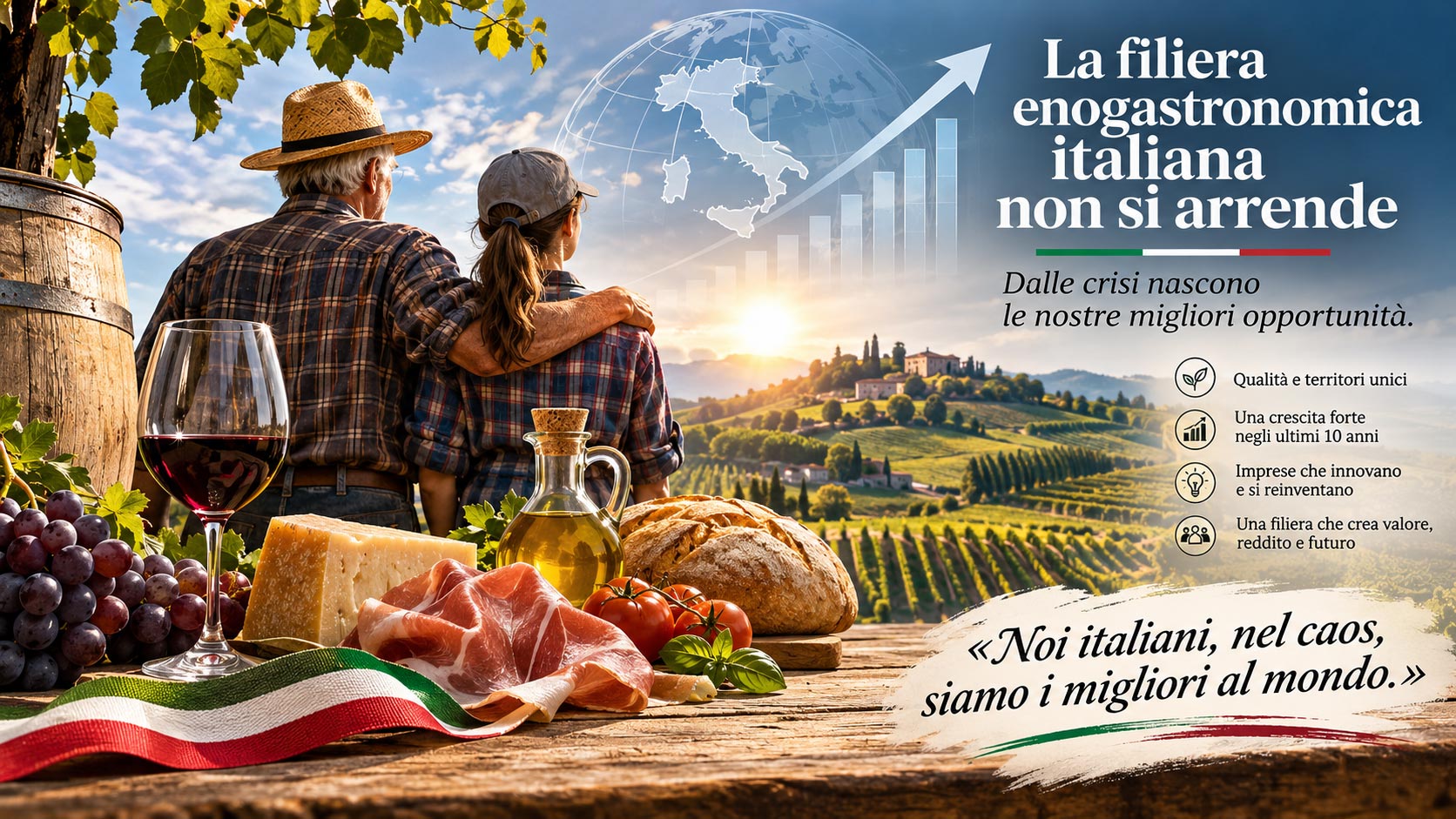
It's a provocative phrase, certainly, but it encapsulates a characteristic that has accompanied generations of Italian farmers, winemakers, producers, artisans, and entrepreneurs: the ability to find solutions when conditions seem impossible.
Italy's food and wine are recognized worldwide for their quality, variety, territorial identity, and the richness of their traditions.
From wine to extra virgin olive oil, from cheeses to cured meats, from pasta to excellent agricultural products, our country has built a productive, cultural, and commercial heritage that is difficult to replicate.
Today, this system is going through a complex phase. International tensions, declining purchasing power, rising costs, climate change, and evolving eating habits are profoundly altering market balances.
But a slowdown doesn't mean the Italian model has exhausted its strength. Rather, it means the time has come to further evolve it.
Ten years of growth that we cannot forget
When analyzing the challenges of 2026, it is important not to lose historical perspective.
Over the past ten years, the Italian agri-food industry has made extraordinary progress, consolidating its presence on international markets and increasing the value of exports.
According to ISMEA data reported by WineNews, in 2025 Italian agri-food exports reached a record 72.5 billion euros , with a 5% growth compared to 2024.
Over the last decade, agri-food exports have recorded an average annual increase of 7.3%, strengthening the sector's weight in the national economy.
It's not just about numbers.
Behind this growth are thousands of agricultural businesses, wineries, cooperatives, food industries, consortia, distributors, and commercial operators who have invested in quality, technology, food safety, certification, and internationalization.
Italian wine is one of the most significant examples.
In 2025, Italy confirmed its position as the world's leading wine exporter in terms of quantity, with approximately 21 million hectoliters exported, and the second in terms of value, with approximately 7.8 billion euros.
Results that demonstrate how our production system has been able to transform a thousand-year-old tradition into a modern international economic force.
2026 presents us with a different market
However, it would be a mistake to ignore the signs of difficulty.
According to data from the Nomisma Observatory reported by WineNews, in the first half of 2026, Italian agri-food exports grew by only 0.5% in value.
A clear slowdown compared to the results of the previous year.
In the wine sector, the Unione Italiana Vini Observatory recorded, in the same period, a contraction in exports of 6.2% in value and 4% in volume.
Global demand is changing. Some traditional markets are slowing, while others are showing new growth opportunities.
Consumers have also changed: they shop more carefully, compare prices and quality, and seek authenticity, sustainability, well-being, and experiences.
For many companies, especially small and medium-sized ones, this means simultaneously addressing issues of margins, liquidity, distribution, and generational turnover.
The real question, therefore, is not just how much to produce, but how much value we can create and retain throughout the entire supply chain.
Italian farmers aren't waiting for the crisis to pass: they're rolling up their sleeves.
Anyone who truly knows the agricultural world knows that difficulties are nothing new.
Italian farmers have faced economic transformations, technological changes, energy crises, international competition, and increasingly unpredictable weather conditions.
Yet they continued to cultivate, invest, improve their products and defend their territories.
Our strength has never been just our ability to produce.
It was the ability to adapt.
When one market closes, we look for new destinations.
When costs increase, we improve processes.
When the consumer changes, we rethink products, packaging and sales methods.
When a small company can no longer compete alone, collaborations, commercial networks, mergers, and new forms of management emerge.
Of course, adaptability alone cannot compensate for every structural challenge. Effective policies, access to credit, infrastructure, research, and more balanced trade conditions are also needed.
But one belief remains: Italian agricultural entrepreneurs cannot simply wait for the market to return to its former state. They must prepare their businesses for the market to come.
From product to value: the great transformation of the Italian supply chain
For many years, a significant part of the success of the Italian agri-food industry has been based on increased production, recognized quality, and the conquest of new markets.
Today these elements remain fundamental, but they are no longer sufficient.
International competition requires a change of perspective.
It's not enough to produce excellent wine if you can't sell it at an adequate margin.
Owning a premium vineyard isn't enough if the company doesn't have the resources to enhance it.
It's not enough to make an excellent food product if the consumer doesn't understand its origin, history, and value.
The future depends on the ability to connect production, territorial identity, commercial organization, and direct relationships with consumers.
A winery can also become a place of hospitality, tasting, culture, and direct sales.
A farm can develop new sales channels, collaborate with other local businesses, and build experiences related to food and wine.
A small producer can find in specialization, shared distribution and digital technologies tools to reach previously inaccessible customers.
Quality remains the starting point. But it's the organization that transforms it into economic value.
Five directions to build the future
The Italian supply chain faces some concrete priorities.
1. Protect profitability, not just volumes. Producing more doesn't necessarily mean earning more. You need to understand real costs, eliminate inefficiencies, and better value each product.
2. Strengthen business networks. Small businesses must be able to maintain their identity, sharing services, expertise, business tools, and market access where possible.
3. Invest in marketing. Export, distribution, digital presence, and consumer relations must become central components of the company strategy.
4. Integrate agriculture, tourism, and experiences. Wine tourism, agritourism, tastings, direct sales, and local development can generate new opportunities, provided they are supported by financially credible projects.
5. Encourage generational turnover and new forms of investment. Acquisitions, industrial partnerships, mergers, investor participation, and professional management can help ensure the continuity of companies that possess great potential but lack the resources to develop it.
Italy's true wealth is diversity
The Made in Italy agri-food sector is not a single large, uniform industrial system.
It is a mosaic of territories, traditions, family businesses, cooperatives, artisanal productions, and structured companies.
From the Prosecco hills to Tuscany, from Piedmont to Sicily, from Friuli Venezia Giulia to Romagna, each region has its own unique products, skills, and histories.
This diversity represents one of our greatest riches.
The future does not necessarily have to transform all companies into large groups.
Rather, it must create the conditions so that even the smallest businesses can compete, collaborate, and earn an adequate income.
Because a farm that closes doesn't just represent an economic loss.
It can mean the disappearance of knowledge, relationships, landscape, employment and territorial protection.
Defending the supply chain therefore means protecting a heritage that goes far beyond the value of individual products.
Crises can accelerate change, but they do not guarantee it.
It is important to distinguish optimism from superficiality.
Not all companies will overcome this phase with the same results.
Some will have to fundamentally rethink their business model. Others will need new capital, new skills, or a different ownership structure.
In some cases, it will be necessary to merge, open up to industrial partners, or consider a sale to ensure business continuity.
Crisis alone does not create opportunities.
Opportunities arise from the decisions that entrepreneurs, professionals, and institutions are able to make to address them.
And this is precisely where the Italian experience can make the difference.
We Italians, in the chaos, are the best in the world
This sentence is not intended to be an economic ranking or a declaration of superiority over other countries.
It is meant to represent a spirit.
That of someone who, faced with a difficulty, does not limit himself to describing the problem, but looks for a solution.
It is the spirit of the farmer who continues to invest in his land, of the winemaker who improves the quality of his wines, of the entrepreneur who finds new markets, of the young person who introduces technologies and ideas without abandoning his roots.
Italy has already demonstrated its ability to transform traditional agricultural products into world-renowned excellences.
Now it must demonstrate its ability to transform this excellence into a more solid, profitable system capable of facing new challenges.
We mustn't simply go back to growing as before. We must learn to grow better.
Conclusion: the future of Made in Italy is being built today
Looking back over the last ten years, it would be wrong to forget how far the Italian food and wine industry has come.
Looking at the present, it would be equally wrong to underestimate the difficulties.
But looking to the future, we have concrete reasons to continue to believe in our abilities.
We possess extraordinary territories, recognized products, production expertise, gastronomic culture, and an entrepreneurial heritage built over generations.
We must put these resources in a position to produce value, income, employment and development.
The next phase of growth won't come automatically. It will require courage, collaboration, investment, and a more modern vision of the supply chain.
Because Made in Italy didn't become great by avoiding difficulties, but by continually learning to overcome them.
And perhaps this is precisely the message we must convey to Italian farmers and entrepreneurs today:
We've built a lot over the past ten years. Now is not the time to give up, but to use what we've learned to build the next ten.
"We Italians, in the midst of chaos, are the best in the world. But our true talent isn't living with chaos: it's being able to transform it into new opportunities."
WINE IDEA News – Analysis and perspectives of the Italian agri-food supply chain
An in-depth editorial dedicated to agricultural, winemaking, and agri-food companies, entrepreneurs, and investors interested in the evolution of Made in Italy.
The numbers that support the article
Agri-food exports 2025
€72.5 billion
5% on 2024
Average annual export growth over the last decade
7.3%
ISMEA data reported by WineNews
Agri-food exports, first semester 2026
0.5%
In value, compared to 2025
Wine exports, first semester 2026
-6.2%
By value, according to UIV
Sources: ISMEA, Nomisma, WineNews, and the Italian Wine Union.
WineNews 2
SEO Optimization and Visibility in AI Responses
SEO Title
Italian Agri-Food 2026: From Crisis to New Opportunities
Meta description
Copy
The Italian food and wine industry is slowing in 2026, but ten years of growth demonstrate the strength of Made in Italy. Challenges, data, and opportunities.
Suggested URL Slug
Italian food and wine supply chain: crisis, opportunity, 2026
Main keywords
The Italian food and wine supply chain, the 2026 agri-food crisis, Made in Italy food, Italian wine exports, Italian agriculture, the future of wineries, agri-food opportunities, agricultural innovation, and winemaking investments.
Editorial sources and documentation

11/11/2026
09/11/2026

26/10/2026

13/10/2026